Back to the Forest
As a city-bred child, I once believed nature was merely a place to escape to. But the deeper I ventured into the forests, the more I understood: nature is where we return home.
To Each Forest, Its Own Leaf
If you’ve seen “Little Forest,” you’ve likely dreamed of living in a charming wooden cabin nestled in the woods, preparing meals from what you’ve grown or foraged nearby, just like the protagonist Ichiko. Our most recent forest expedition took us to Lac Duong in Lam Dong Province. There, I met an endearing forest ranger. Each day, he’d ride his ancient Dream motorcycle—barely more than a frame—bouncing along the dirt roads to the market to buy the freshest ingredients from local villagers. At noon, he’d cook rice with fried dishes, braised meats, stir-fried vegetables, and steaming soup. Come evening, he’d lay out chicken congee, duck hotpot, and fragrant fish hotpot. Some days, he’d ask his ethnic minority friends to wade upstream deep into the forest to catch fish. He reminded me of the saying “rừng nào, lá nấy”—to each forest, its own leaf. This folk proverb carries a philosophy of harmony, adaptation, and sustainable development. But it also holds a more everyday meaning: people live on the gifts the earth bestows. Each dish is a cross-section of the land and sky, a crystallization of climate, soil, and human hands. When we eat a plate of forest greens, a stream fish, or a bowl of rice cooked with crystal-clear spring water, we’re not merely eating to satisfy hunger—we’re receiving a piece of that place’s soul.

Nearly eight years ago, when tourism services in Sapa weren’t yet booming, during a trek from Cat Cat village through the forest into the mountains, I encountered groups harvesting black cardamom. They didn’t pick—they gathered, meaning they waited for the fruit to ripen red and fall onto the layer of decaying leaves before collecting them. The locals told me black cardamom must be harvested in season, around August through October. Picking them early not only diminishes quality but also affects the plant’s growth cycle. The seeds need only be roasted, ground fine, and used to marinate meat with mắc khén (Sichuan pepper), creating that intensely spicy, deeply aromatic flavor characteristic of the Northwest region. That deliciousness is the essence of cool climate, moist forest soil, and the skillful hands of indigenous people.
Another time, in a primary forest near Lake Lak in Buon Ma Thuot, a young M’Nong man showed me how to eat kơ nia nuts. The kernels are ivory-white, starchy, slightly astringent. Locals typically wait for the fruit to ripen and fall, then sun-dry them, extract the nuts, and roast them or package them to sell as a nutritious food. The flavor of kơ nia nuts resembles almonds or cashews but is far more rustic and wild.

On that same trip, a local forest ranger treated me to steamed fish with finely chopped cassava leaves. Cassava leaves, or young tapioca leaves, are picked at dawn to preserve their sweetness, washed clean, pounded smooth, then sautéed with a touch of salt before mixing with the steamed fish. The rich, mild flavor paired with white rice is both refreshing and satisfying. No elaborate seasonings needed, no fancy presentation—simply being in the forest, eating forest food, and I felt an unusual sense of peace.
Creativity Is Nature’s Essence
I remember the first time I tasted green papaya salad with yellow ant salt—a specialty of the Ê Đê people and other Central Highlands ethnic groups. I was astonished, wondering how something so simple could be so unique. The dish consists only of green papaya and yellow ant salt. The papaya must be the crisp variety, sweet and fresh, peeled, rinsed of sap, then chopped or hand-pounded to maintain crispness. Yellow ant salt is a seasoning made from roasted yellow ant nests, ground with rock salt and forest chili, producing a mixture that’s sour-spicy, pungently fragrant, and slightly rich. When mixing the salad, people add just a touch of vinegar and a bit of sugar to balance the flavors. This dish can awaken all the senses—bold yet retaining the wildness of the mountains.
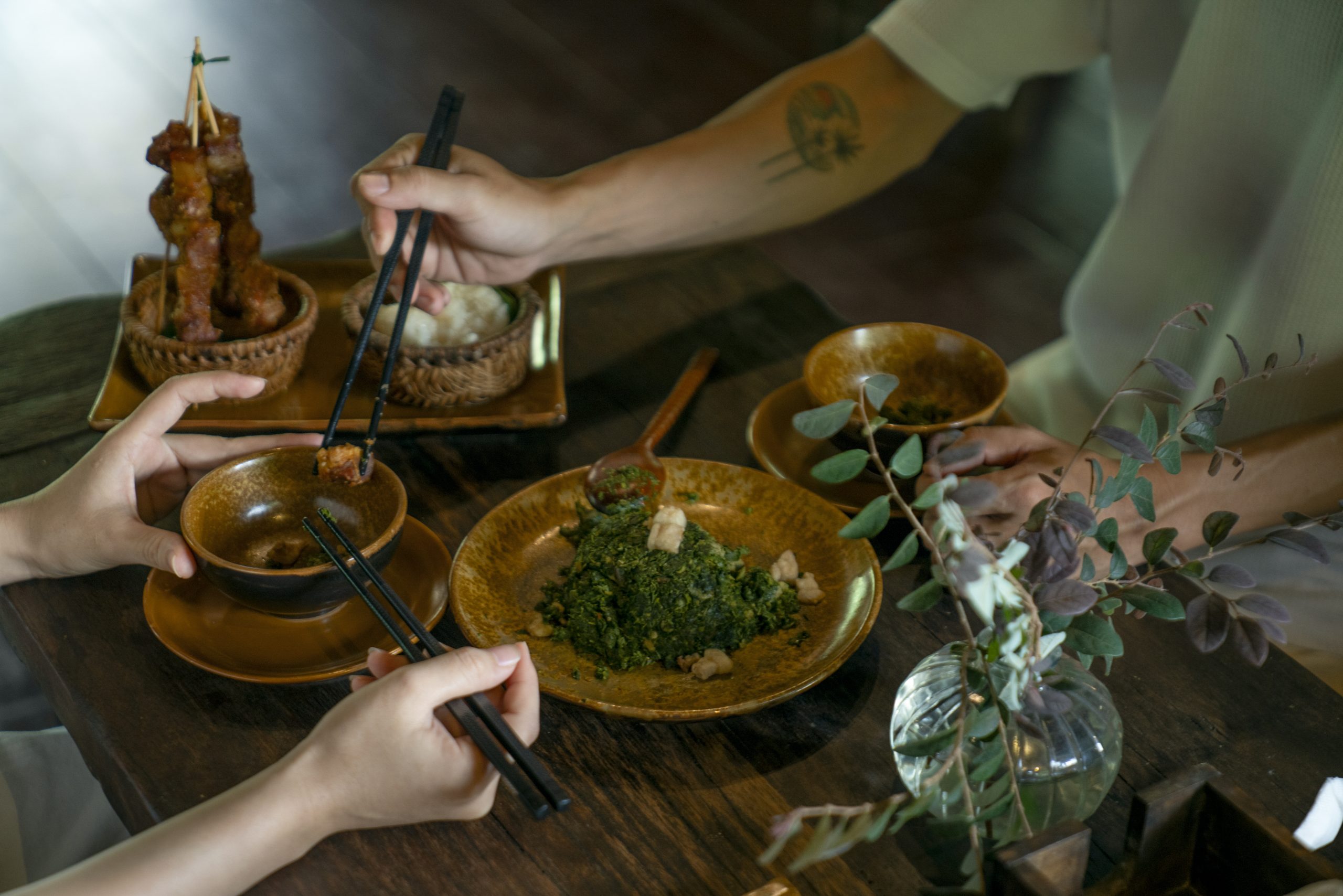
The unusual combination of pennywort and forest bamboo shoots in the salad of the Northwest highlands people also impressed me. Both carry bitterness: young pennywort with a clean bitter note, early-season forest bamboo shoots crisp and cooling with a gentle bitterness. Yet when boiled, drained, then tossed with rock salt, lime juice, fresh chili, and crushed roasted peanuts, they harmonize into a refreshing, simple yet pleasant dish. A Tày woman told me that harvesting forest bamboo shoots is arduous work: rising early, following faint trails into the forest, looking for cracked earth or lifted leaves to find shoots. When they spot one, they cut close to the base to preserve the mother plant, then bundle them to carry home. Bamboo shoots, dendrocalamus shoots, schizostachyum shoots, ampelocalamus shoots—each has its own flavor, and locals typically know how to prepare each variety.
Every plant, every flower in the forest can connect with people in some way. In Ha Giang, there’s a cake made from buckwheat flowers. After harvest, the seeds are sun-dried, roasted until fragrant, then ground into a fine flour that takes on a gray-brown hue, redolent of rocky mountains and highland winds. When making cakes, people mix the flour with warm water, sometimes adding a bit of sugar or wild honey for gentle sweetness, then shape them into small, flat pieces and drop them onto a hot cast-iron pan. The finished cakes are golden-brown, edges slightly crisp, interior soft and fluffy, fragrant and rich, not cloyingly sweet but delicately savory. In the sharp cold of an early market morning, holding a piping hot cake, I felt as though I was savoring a piece of the soul of this stone plateau where flowers bloom.

I still vividly remember squealing with delight in the middle of Y Ty market when I discovered củ niễng—an ingredient that only appears in winter in the highlands. White-bodied, crisp and sweet, củ niễng is stir-fried with pork or smoked buffalo meat for a wonderfully aromatic dish. We bought củ niễng along with other ingredients to take to San village of the Ha Nhi people in Bat Xat to cook a meal for the community. Ingredients that locals hand-picked from the forest always carry a raw beauty: forest greens bundled with rattan strips or vines, uneven but sturdy; củ niễng arranged in small bundles, tied with dried banana fiber. That evening, deep in the mountains without electric lights, the meal was cooked early, children chattering around the fire, laughter echoing through the wooden house. When darkness fell completely, everyone gathered around, sharing the meal beneath a sky full of stars.
The more I explore the culinary world with the mindset of “each forest has its own leaves,” the more I realize that creativity is simply nature being itself. Eastern philosophy says, “All things arise from the Tao, and eventually return to the Tao.” In that flow, returning isn’t retreat — it’s renewal. At every stage of life, each of us needs our own way of going back to our roots, so we can answer the timeless questions: Who am I, and what can I offer this life?

Originally published in Đẹp Magazine, Issue No. 303