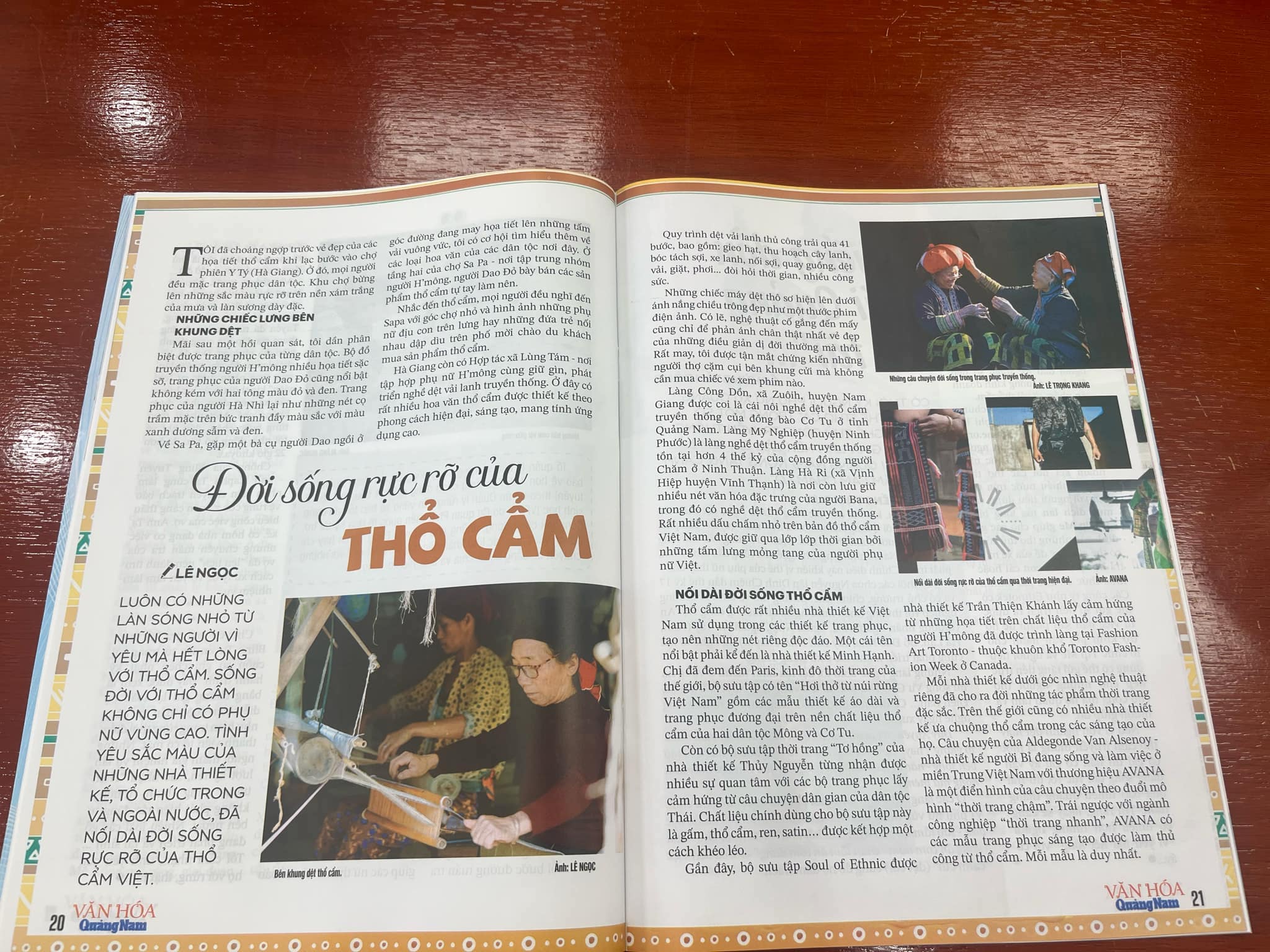
The Vibrant Life of Brocade
There are always small waves from those who wholeheartedly love brocade. Living with brocade is not only for highland women. The love for colors from designers and organizations, both domestic and international, has extended the vibrant life of Vietnamese brocade.
“I was overwhelmed by the beauty of the brocade patterns when I wandered into the Y Tý market (Hà Giang). There, everyone wore traditional ethnic costumes. The market burst into vibrant colors against the gray-white backdrop of rain and thick fog.
The backs at the weaving looms
After a while of observing, I gradually distinguished the costumes of each ethnic group. The traditional attire of the H’mông people is full of colorful patterns, while the clothing of the Red Dao people is equally striking with its red and black tones. The attire of the Hà Nhì people, on the other hand, resembles somber brushstrokes on a colorful painting with dark blue and black hues.
In Sa Pa, I met an elderly Red Dao woman sitting by the roadside, sewing patterns onto square pieces of fabric. I had the opportunity to learn more about the various ethnic patterns here. On the second floor of the Sa Pa market, where the H’mông and Red Dao people gather, they sell handmade brocade products.
When mentioning brocade, everyone thinks of Sa Pa with its small market corners and the image of women carrying children on their backs or children trailing along the streets, inviting tourists to buy brocade products.
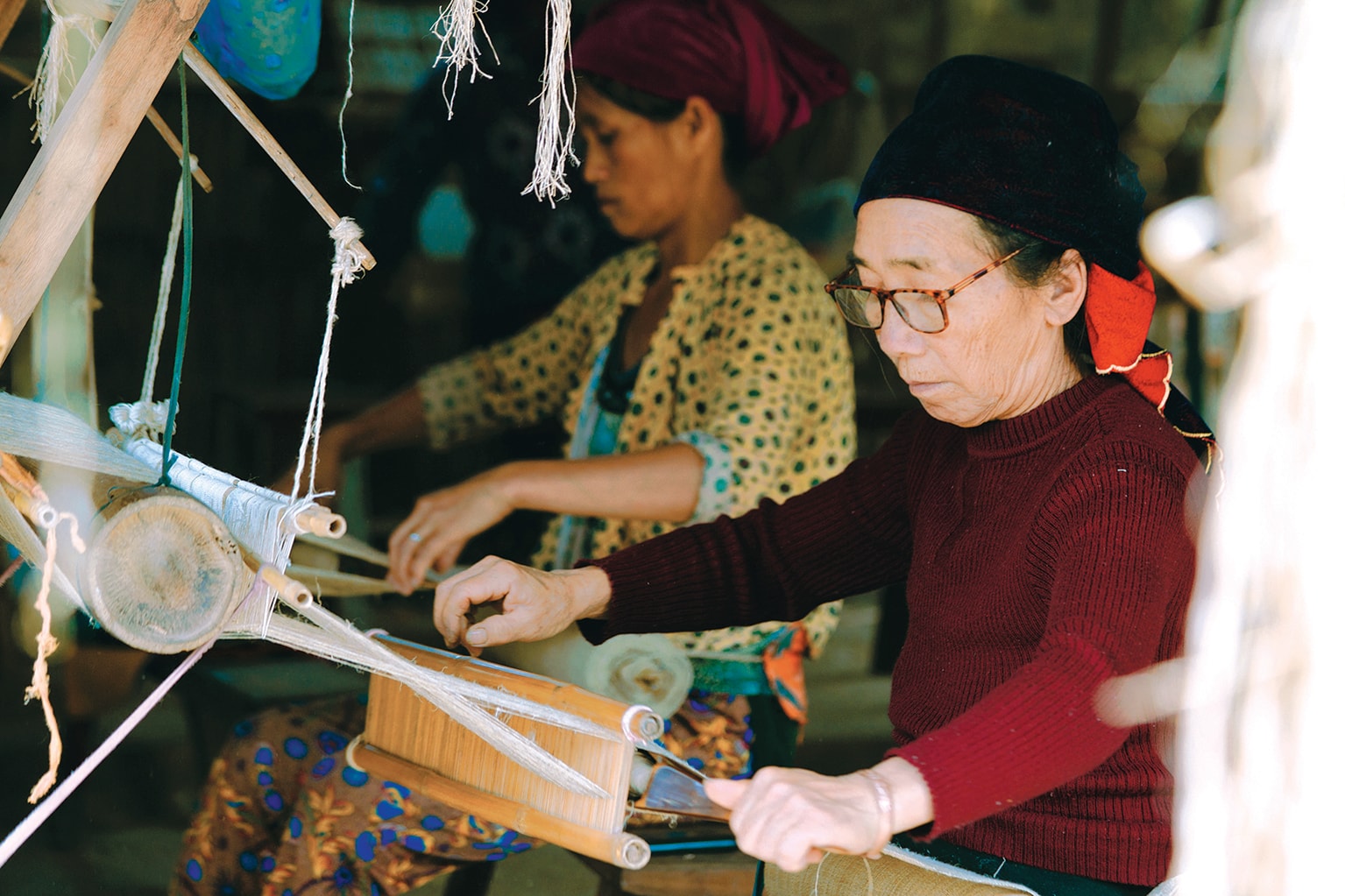
Hà Giang also has the Lùng Tám Cooperative, where H’mông women gather to preserve and develop the traditional flax weaving craft. Here, many brocade patterns are designed in a modern, creative style with high applicability.
The manual flax weaving process goes through 41 steps, including: sowing seeds, harvesting flax, peeling fibers, spinning flax, joining threads, winding, weaving fabric, washing, drying… requiring time and a lot of effort.
The rudimentary weaving machines under the afternoon sun look as beautiful as a cinematic scene. Perhaps, no matter how hard art tries, it can only truthfully reflect the beauty of the simple everyday things. Fortunately, I got to witness the diligent weavers at their looms without needing to buy a movie ticket.
Công Dồn village, Zuôih commune, Nam Giang district is considered the cradle of the traditional brocade weaving craft of the Cơ Tu people in Quảng Nam province. Mỹ Nghiệp village (Ninh Phước district) is a traditional brocade weaving village that has existed for over four centuries of the Chăm community in Ninh Thuận.
Hà Ri village (Vịnh Hiệp commune, Vĩnh Thạnh district) is a place that still preserves many cultural characteristics of the Bana people, including the traditional brocade weaving craft. There are many small dots on the map of Vietnamese brocade, preserved through layers of time by the delicate backs of Vietnamese women.

Extending the Life of Brocade
Brocade is used by many Vietnamese designers in their clothing designs, creating unique and distinctive features. A prominent name to mention is designer Minh Hạnh. She brought to Paris, the fashion capital of the world, a collection named “Breath from the Mountains of Vietnam,” featuring áo dài and contemporary outfits made from brocade of the Mông and Cơ Tu ethnic groups.
Another notable collection is “Pink Silk” by designer Thủy Nguyễn, which received much attention with outfits inspired by the folklore of the Thái ethnic group. The main materials used for this collection are brocade, silk, lace, satin, etc., skillfully combined.
Recently, the “Soul of Ethnic” collection by designer Trần Thiện Khánh, inspired by the patterns on brocade of the H’mông people, was showcased at Fashion Art Toronto, part of Toronto Fashion Week in Canada.
Each designer, with their unique artistic perspective, has created remarkable fashion pieces. Globally, many designers also favor brocade in their creations.
The story of Aldegonde Van Alsenoy, a Belgian designer living and working in Central Vietnam with the AVANA brand, is a typical example of pursuing the “slow fashion” model. Contrary to the “fast fashion” industry, AVANA’s creative outfits are handcrafted from brocade, with each piece being unique.
An American founded the Ethnotek brand, specializing in selling travel bags with minimalist designs, focusing on functionality but featuring unique brocade fabric patterns. Jake Orake, an American who once wandered throughout Vietnam, fell in love with the brocade of ethnic minorities and came up with the idea of creating products from brocade fabric.
Through Ethnotek, we learned about the non-profit organization Tip Me, founded by German Helen Deacon. This organization aims to connect artisans worldwide with consumers to spread gratitude.
Tip Me helps artisans’ families raise funds to repair motorbikes, pay school fees for their children, or buy food for their families. Companies like Ethnotek can send a portion of the proceeds from product sales to support Tip Me’s operating costs, and consumers can directly tip the artisans they care about and want to help.
If we liken the traditional brocade weaving industry to a girl, she is still living a vibrant life despite many ups and downs. We believe that more and more people will “love her wholeheartedly”…
Article published in Quảng Nam Newspaper, October 2024.