Director Việt Linh: Staged Reading as a Theatre Without Lights
Director Việt Linh, founder of the Hồng Hạc theatre collective, is the first to bring staged reading to Vietnam. She created it for those who long to read but lack the time or the means. To her, transforming a several-hundred-page novel into a play or a hundred-minute film is another way of blending literature with life. Through that process, knowledge grows fuller and the soul grows gentler.
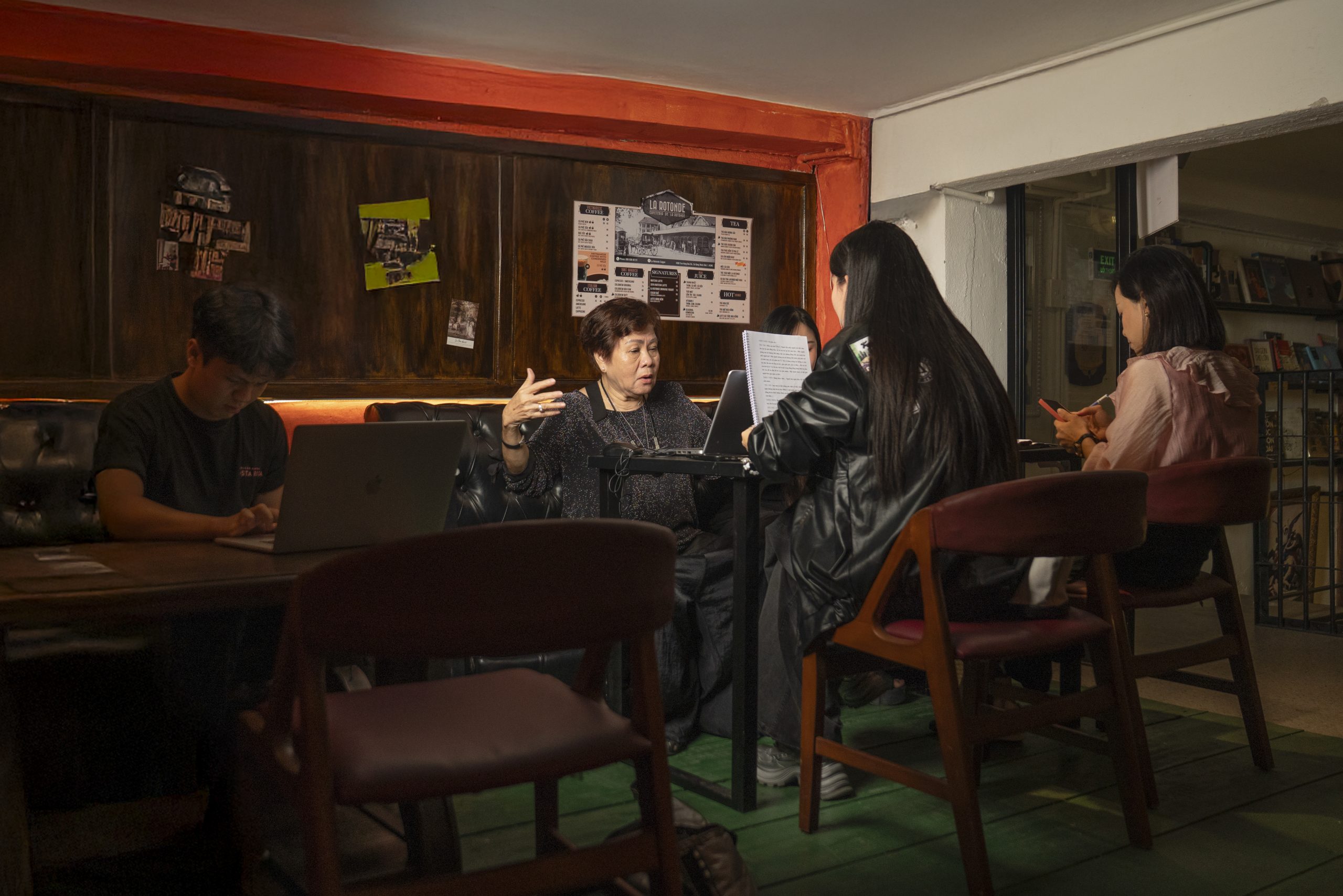
When the Stage Exists Inside the Listener’s MindThe lights came on, and director Việt Linh stepped forward with members of the Hồng Hạc troupe to greet the audience. Their lively energy contrasted with the quiet atmosphere that permeated the staged reading moments before. It was a late-2024 performance at Họa Sĩ Café in District 1, Ho Chi Minh City. Literary and cultural scholar Nhật Chiêu was among the attendees. He said it was his first encounter with staged reading and that he was captivated because “while listening to staged reading, the stage is constructed inside each person’s mind through their own imagination.”
“When I studied directing in Russia, I realized during rehearsals and script readings that the voice exposes everything about one’s soul and state of mind. Acting is fundamentally about pretending, but that pretense is only a third of what’s happening. The core is always real emotion. Since childhood I’ve been drawn to sound; it gives me far more room for imagination than images do. When I encountered staged reading, I felt it aligned perfectly with Hồng Hạc’s mission to spread literature, because it hands the audience one hundred percent of the imaginative power,” director Việt Linh shares.
 In many staged readings around the world, the audience still sees the performers. In Hồng Hạc’s productions, however, the actors remain completely out of sight. They perform from a separate room, a hidden corner, or behind a curtain. Once the music and narration begin, listeners fall into the theatre of their own minds. Every story and every line of dialogue interacts with each person’s private emotions and life experiences.
Book lovers will likely find a sense of familiarity in Hồng Hạc’s staged readings, as most performances are adapted from literature and distilled into essential scenes and potent lines. Over the hour-long duration, the work unfolds through a series of short acts, each leading the listener into a new space, story, or feeling. There is no transitional music between scenes. The “transition” is the lingering emotional resonance from the scene before.

Transmitting Emotion Through the Voice
I have attended two staged readings, and the one that left the deepest impression was “Thiên Thiên”, adapted from the short stories “Hạnh phúc là cùng” by Vũ Hồi Nguyên and Xoa by Tăng Song Nam. The protagonist, “Thiên Thiên”, played by director Việt Linh herself, is a woman who has endured both physical and emotional pain. She lives in seclusion inside a small house in a working-class alley, and her unusual job is to listen to the stories of strangers, whether they speak of happiness, sorrow, confusion, anger, or loneliness. At times she offers comfort or advice, but mostly she simply listens, speaking only a few brief words in return.
Việt Linh recalls that when she launched the staged reading platform in June 2024, she ended up taking the role of Thiên Thiên after several other options felt unsuitable. “My voice isn’t as polished as that of a broadcaster, but I understood the spirit of the story. I knew I could express the character’s inner world in the truest, most resonant way, and pass that emotional vibration on to my fellow performers and the audience. I wasn’t surprised that viewers embraced Thiên Thiên so strongly, because in those moments she and I had become one.”

She adds that staged reading follows the same principles as traditional theatre. An actor can rely on technique and craft as long as they deeply understand the script. But the most transcendent performances happen when the actor and the character share either similarities or striking contrasts. As in real life, there are two types of journeys that make the heart race: going somewhere new or returning home. Acting works the same way.
The Beauty of Sound
Actors at Hồng Hạc agree that staged reading is more demanding than traditional theatre, because everything depends on the voice. On stage, audiences can read emotion through costume, movement, and facial expression. In staged reading, the voice must carry everything. How do you convey emotion with no tools except breath, tremor, laughter, sobs?
According to director Việt Linh, actors must imagine the world of the play as vividly as if it were real. You cannot say “I love him” or “this is my home” without knowing how he looks or what that home feels like. Dialogue needs memory to carry emotion. She reveals, “During rehearsals and even in live performances, there are moments when I’m moved by the sheer beauty of the voice. Sometimes the actor’s tears are real, or they cough and try to turn it into a sound of heartbreak.”

For many years, Việt Linh has traveled between Vietnam and France. French culture and lifestyle have clearly shaped her creative sensibilities, visible in the elegance and refinement she brings to her work and daily life. Every time she returns to France, she makes time for films, exhibitions, and performances, which she calls “a kind of sedimentary vitamin for the soul.”
She considers herself someone who loves listening and is highly sensitive to sound. She is always imagining, always hearing shapes and textures in moments of stillness and silence. To her, the sounds of life are an infinite artistic material and a priceless resource for understanding people. In daily communication, she prefers conversations over messages or emails. When casting actors, she rarely watches them act. She listens instead.
Director Việt Linh
Việt Linh graduated with distinction in Directing from the National State Institute of Cinematography of the Soviet Union (VGIK) in 1985.
Her notable films include “Gánh xiếc rong”, “Dấu ấn của quỷ”, “Chung cư”, and “Mê Thảo – thời vang bóng”, all of which earned awards at both domestic and international film festivals.
She married and built a life in France but retains her Vietnamese citizenship and currently works primarily as a screenwriter, director, and artistic director at Hồng Hạc.
Since 2006, she has authored and edited the long-running Cinema Bookshelf (Tủ sách Điện ảnh), which includes titles such as “Dạo chơi vườn điện ảnh”, “Ý tưởng nghề nghiệp”, “Chơi cùng cấu trúc”, “Khung hình tự sự”, “Hai mươi bài học điện ảnh”, and “Gọi tiếng cho hình”.
Originally published in Đẹp Magazine, Issue 299
Photography: Ngọc Ánh