Xuân Phượng – The Beauty of Life Follows Us Until the Last Moment
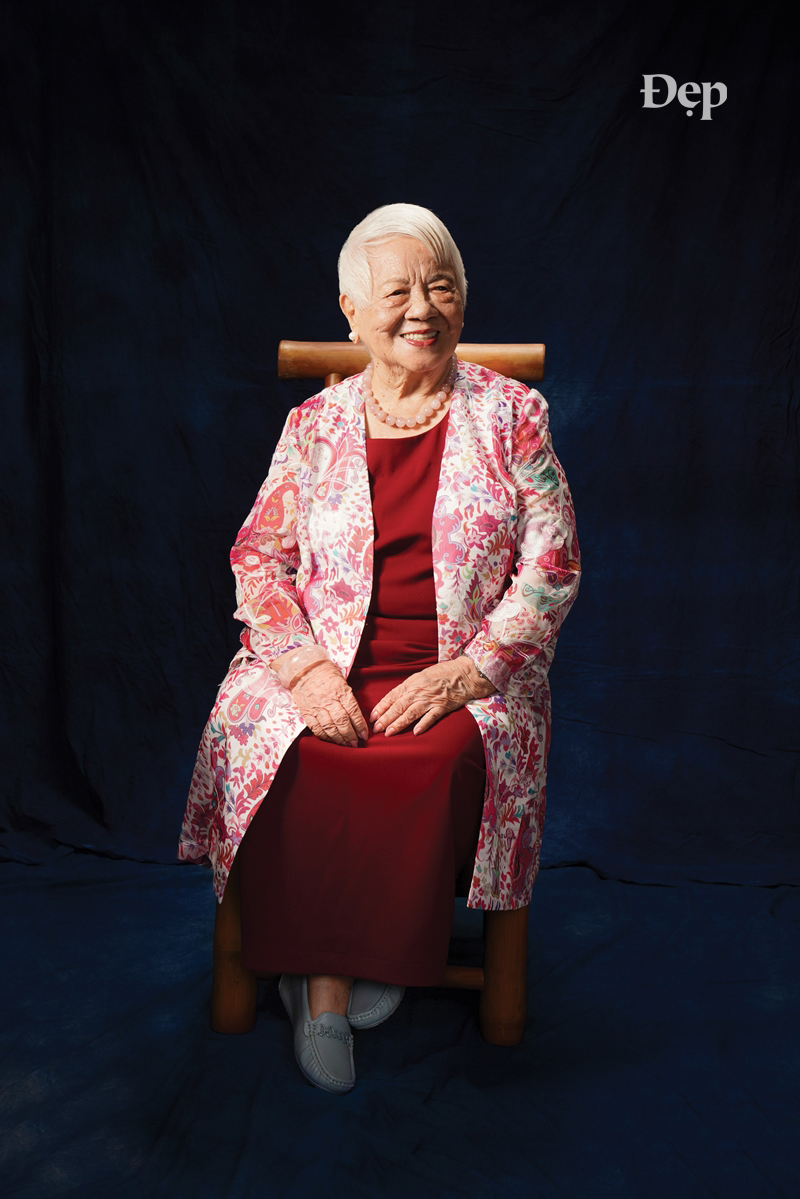
At 95, with a cane in her right hand, leaning against walls or needing assistance to move, and skin marked by time, Xuân Phượng still exudes the aura of a youthful maiden. Her bright eyes, powerful voice, and sharp mind allow her to adeptly manage tasks on both a computer and a smartphone. She dons elegant and sophisticated outfits, always accessorized with earrings, jade bracelets, and matching watches. Her lips are adorned with a pink lipstick, and she always wears a radiant smile.

“Hello Phượng! I don’t know you personally, but today I want to send you a letter. My husband is an engineer. Since retiring, he hasn’t left the house, only eating in his room and avoiding social interaction. I was very worried. Until one day, I gave him your book ‘Áo dài’ to read, and suddenly the next morning, he was out in the garden watering plants and humming. I was astonished and asked him why. He thanked me for giving him the book by a Vietnamese author. He felt ashamed in front of her and wanted to live at least as worthy as this Vietnamese woman. I was so happy that I wrote this letter to thank you.”
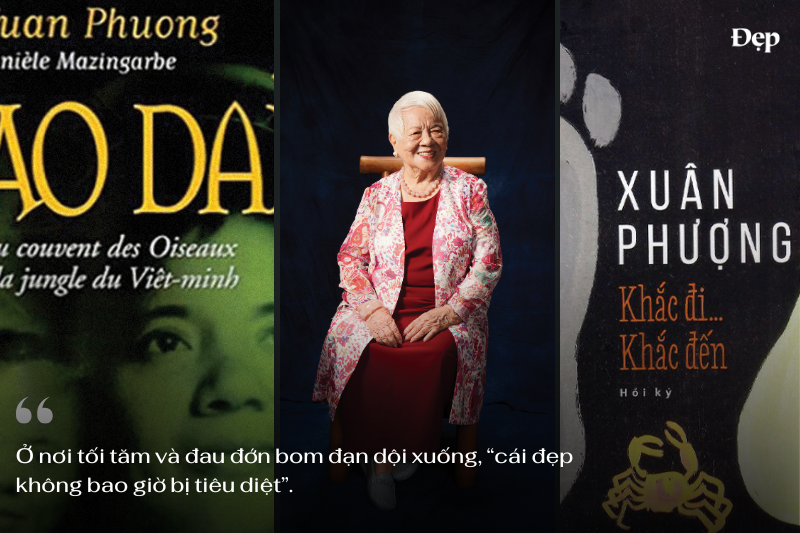
This is a summary of a letter from a French reader to Xuân Phượng about her memoir “Áo dài” (written in French, published in 2001). This book has also been translated into English and Polish, showing that Xuân Phượng’s stories resonate not only with domestic readers but also with audiences worldwide. Nineteen years later, “Gánh gánh… gồng gồng…” was published when Xuân Phượng was over 90. Four years later came her next memoir, “Khắc đi, khắc đến.” I must share some unrelated anecdotes to help readers understand why many people not only admire but also genuinely love Xuân Phượng and affectionately call her the “young writer.” Our “young writer” is incredibly humorous. She once asked me how to publish a small volume of poetry because “a young girl she knows writes lovely poems.” A moment later, I heard her calling someone else to ask the same thing. This time, she said, “That young girl is only 60 years old!” Another time, she shared a memory from her days as a military doctor: “I might be the only Vietnamese person who has ever taken Fidel Castro’s blood pressure.” When I asked if she had any message for all women on October 20th, she said, “Ah, if I have to send a message, it would be for those under 90 years old…”.
One must also mention the moments when the “young writer” eagerly awaits something, looking like a twenty-year-old maiden. The story goes that Trần Đại Thắng, Director of Đông A Books, promised to bring her the book “Lịch sử Việt Nam bằng hình” (Vietnamese History in Pictures). This monumental work, created over 17 years by a group of history enthusiasts, is something a historical witness like her would deeply appreciate. Throughout our conversation, she kept checking her phone for his call. When he arrived, she warmly welcomed him, carefully turned each page of the book, and repeatedly praised it: “So beautiful,” “So wonderful,” occasionally patting his shoulder and saying, “So talented,” “How did you capture this picture so well?” She was also delighted to see other historical witnesses featured in the book. With the same enthusiasm, she hunted for tickets to the Italy Film Festival 2024, just like young people chase tickets to their idol’s concert.
Beauty is Indestructible
The “young writer” is not only humorous but also an aesthete. This can be affirmed by the way she chooses her outfits, converses with everyone with respect, cherishes beautiful values, and conveys humanistic messages through each page of her books. During the tumultuous wartime, did she ever long to see beautiful things again? Xuân Phượng recounted the bloodied bare feet of a young lady who fled her family to join the resistance, and the very feminine pains, just like what Belarusian writer Alexievich recorded in her book “War’s Unwomanly Face”: “I can’t. I don’t want to remember. Three years of war… And for three years, I was no longer a woman. My body slept… Yet I was once a beautiful woman.” But she also affirmed that in the darkness and pain of bombings, “beauty is never destroyed.” Every night, she tried to recall her grandmother’s garden, her mother’s zither music, and the peaceful years of her childhood. This way, her soul stopped wavering in the face of harsh and brutal reality. Her first book was titled “Áo dài,” symbolizing the Vietnamese woman of the early 20th century, who, through war, became even more beautiful upon independence. She also shared many stories about beauties that, according to her, will never fade with time.
“The self-portrait by artist Trương Đình Hào was highly sought after by many in France, but I refused to sell it because I cherished it deeply. He painted this piece in a moment of near despair, almost committing suicide due to his inability to sell his paintings and provide for his family. However, a bucket falling into a well startled him, causing a bottle of pesticide to spill on the floor, and the sight of ants struggling made him shiver. He decided to paint himself in that moment to remind himself to stay determined to live. So poor that he had no drawing paper, he painted on newspaper. Look at the eyes, full of sadness and anger, not understanding why life treated him so harshly. Very simple yet incredibly difficult to capture! The oversized hands symbolize determination. The striped lines resembling prison clothes express a feeling of entrapment. The red details in the corners of the painting represent hope and a desire to live. Over there, look at the eyes in Nguyễn Tư Nghiêm’s painting of the actress. The vacant gaze, with just a few strokes, evokes sympathy for the woman’s fate. Beauty doesn’t lie in the faces in the paintings, but in the depth of the story behind them.”
“During a trip to France, I told a group of French people about the pain of bare feet. When I left, they gave me a box containing several pairs of high-heeled shoes made of chocolate. Or, there was a New Year in the war zone, deep in the forest, where dozens of Finance Ministry members gathered. The Minister at the time, Lê Văn Hiến, called the children over, saying he was too poor to give them money, so he gave each child a sugar cube to sweeten the new year. Decades later, they still remember it vividly. When you show concern for those around you in their sorrow, it is a beautiful gesture.”
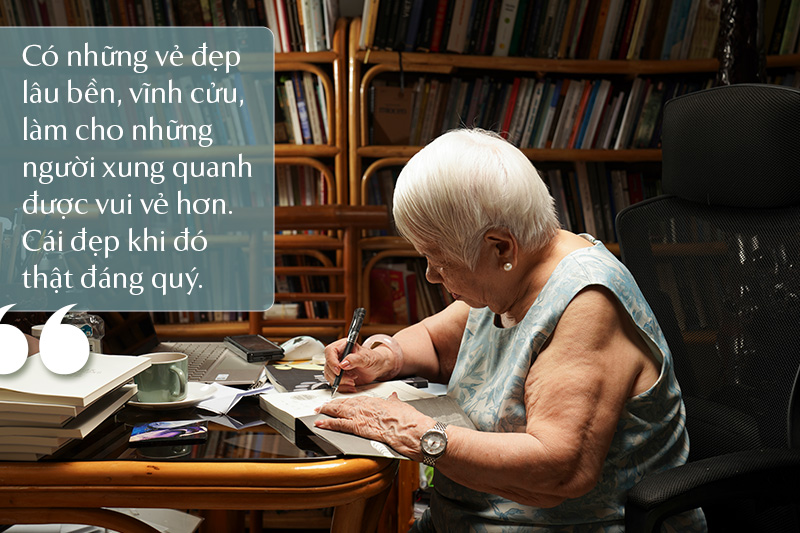
“Or this, in 1977, my eldest son’s wedding was simply organized. A vase made from a 120mm artillery shell brought back from Điện Biên Phủ was used to hold flowers. Do you know what the wedding feast was? The state provided 5 packs of Tam Đảo cigarettes and 5 kilograms of roasted peanuts. Then Trần Tiến rode a bicycle, carrying Trịnh Công Sơn on the back, who was visiting Hanoi for the first time, to the party, saying they had no gifts, so they sang a few songs for fun, singing from 5 PM to 8 AM the next day. There are enduring, eternal beauties that make those around happier. Such beauty is truly precious.”
Don’t Just Look, See
“When you understand the depth of an issue, beauty reveals itself differently. When you look at a beautiful bouquet, you must see the effort behind it—how the seeds were chosen, how it was nurtured through sun and rain, how it was protected, and how it blossomed. The concept of looking and seeing profoundly impacts life. Looking and seeing with an open heart naturally brings about compassion. For example, someone’s attitude might make you dislike them, but if you see and understand their circumstances, empathize with them, you won’t hold a grudge, and you’ll feel more at peace,” Xuân Phượng repeatedly emphasized this point.
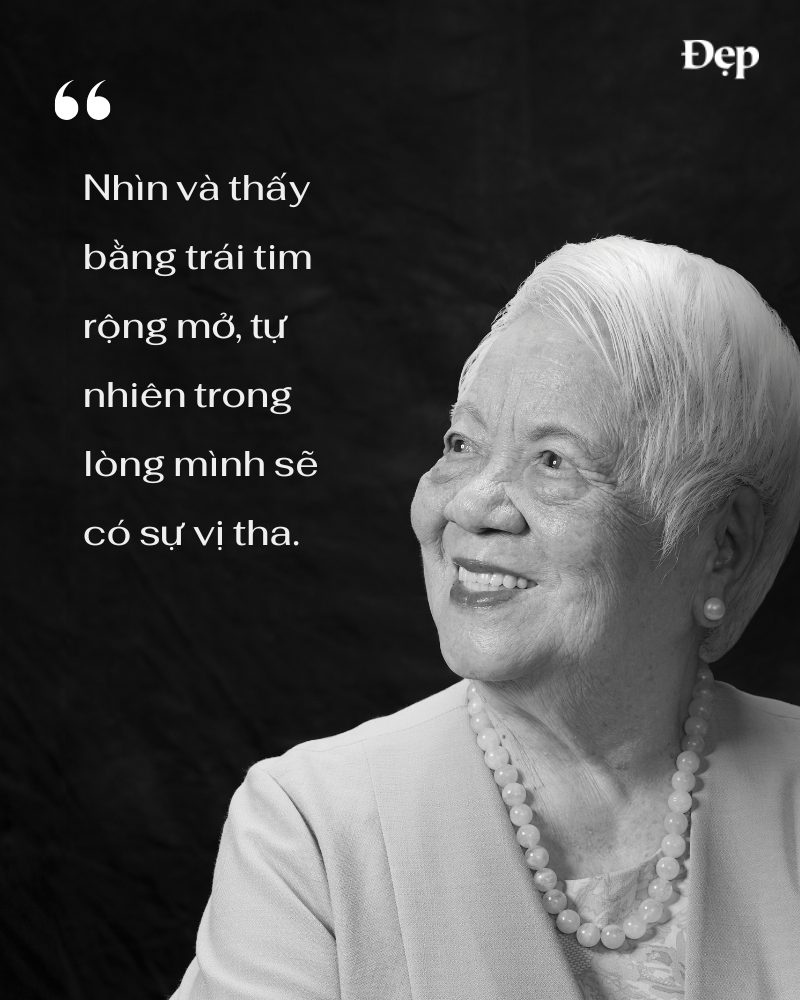
“It’s not easy, is it?” I asked. “At what point did you feel that your inner self had matured enough to clearly understand everything and change yourself?” Xuân Phượng laughed heartily, “Yes, it’s very difficult, but I managed. I used to get very angry and shout a lot, but there was a moment that made me determined to change. I once lent money to a friend, and she never paid it back. I told everyone she had cheated me. Then one day, her daughter came to me and said that when she grew up, she would repay the money her mother had borrowed. Her mother had been abandoned by all her friends. I was shocked because I didn’t realize my anger could affect an entire family. I went to understand their situation, apologized, and we cried together. Since then, I have reminded myself to be very careful, to understand why people act the way they do with a loving heart.”
Tang Poetry and French Literature
To be able to see and feel beauty so deeply, Xuân Phượng firmly believes that “cultures complement each other.”
“I have often told young people that just by learning another language, you can absorb an entire civilization. I remember a trip to Singapore where I had the chance to hear Lee Hsien Loong speak about how to connect different ethnic groups. He said that parents send their children to school not only to learn a foreign language but also to learn how to approach the world’s progress. For example, how to use an elevator, how to go up the supermarket stairs, how to catch a bus, how to take the subway… The idea is to prepare Singaporeans to face the world’s advancements without being overwhelmed. When parents teach their children to have an open attitude towards the world’s progress, the Singaporean nation will immediately unite.”

Bà Xuân Phượng may mắn thụ hưởng cả hai nền văn hóa. Thuở bé, ông nội thường đọc thơ Đường cho bà nghe và có một câu bà rất thích: “Hoàng hà chi thủy thiên thượng lai”, nghĩa là “Nước sông Hoàng Hà chảy từ trên trời xuống”. Nhớ về ông, bà còn nhớ một đêm trăng khuyết, ông gọi các cháu đến và đọc lên câu thơ: “Móng vàng ai bấm trời tây”. Khi đó, bà cảm nhận được một vẻ đẹp sang trọng và thầm kín của thiên nhiên.
Những năm học trường Pháp, bà gặp được một bà giáo giảng văn học Pháp khiến học trò say mê vô cùng. Một bài thơ nọ kể về hành trình của hai con kiến đi dự đám tang của một con kiến khác. Hai con kiến bắt đầu lên đường từ mùa đông, trời xám xịt, chúng vừa đi vừa buồn bã nghĩ đến cái chết của bạn mình; trê
Xuân Phượng has been fortunate to experience both cultures. As a child, her grandfather often recited Tang poetry to her, and one of her favorite lines was: “Hoàng hà chi thủy thiên thượng lai,” meaning “The waters of the Yellow River flow down from the sky.” She recalls a crescent moon night when her grandfather gathered the grandchildren and recited: “Golden claws scratch the western sky.” At that moment, she felt the elegant and hidden beauty of nature.
During her years at a French school, she had a literature teacher who made French literature incredibly captivating for the students. One poem described the journey of two ants attending the funeral of another ant. They started their journey in winter, under gray skies, mourning their friend’s death; on their way back, it was spring, flowers bloomed, the sun rose, the water was clear, and the ants drank delicious wine, forgetting their sorrow.
Thus, beauty is not far away but lies within our hearts. “Our ancestors had a saying that I want to share with today’s youth: ‘Even torn paper must keep its margins.’ The margins here represent the education from family and society. If we strive to maintain this, it naturally forms a person’s character. Character is extremely important. People may dislike you or speak ill of you, but no one has the right to despise you.”
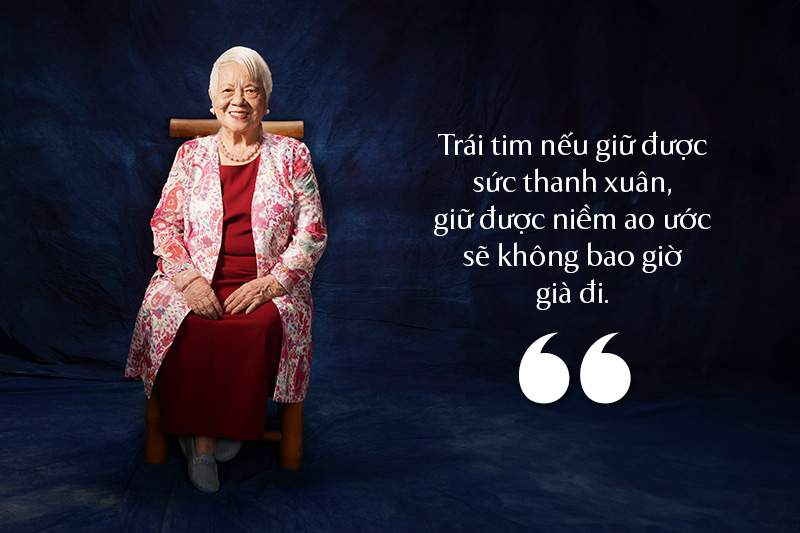
Currently, Xuân Phượng is nearly finished with her next memoir, recounting the war zones she has traversed. Her schedule is packed with work, seminars, and lectures. On days she doesn’t go out, her routine at home is consistent: waking up at 5:30 AM, doing yoga, having a leisurely breakfast until around 10 AM, then writing for two hours, followed by lunch, a nap, and writing again from around 3:30 to 4 PM for another two hours. She hopes her memoir will convey the message that beauty knows no age limits. If the heart retains its youthfulness and desires, it will never grow old. Every moment of life is too beautiful to waste!
_Article published in the October 2024 issue of Đẹp Magazine.
FEATURE: AGELESS SOUL
The beauty of emotions, creativity, kindness, the beauty of steadfast will, and the courage to take risks—these beauties of the soul are timeless. Once they begin to bloom in a woman, they never fade but only flourish more over time. It is even more wonderful when a woman can gracefully leave the mark of her beautiful soul in books, films, and works of art.
Recently, the BBC (UK) announced its list of “100 Most Inspiring Women of 2024.” Among the honorees is Vietnamese director/ writer Xuân Phượng. This annual list celebrates outstanding women who have continuously overcome challenges and made significant contributions to changing the world.