Hannah Gellens: A Special Triangle with Two Mothers
“I was only nine months old when my adoptive parents came to Vietnam and brought me to Belgium. My first memory of being adopted is when I was two, my Belgian adoptive parents took me back to Vietnam to meet my younger brother. He was adopted too.”
These are the words of Hannah Gellens, a Belgian of Vietnamese origin currently living and working in Vietnam. When people ask why she speaks English with a European accent while having Asian features in her eyes and hair, Hannah always shares her background openly and candidly.
Two Mothers
Hannah loves languages. As a child, she wrote short stories about her dog, turning it into a superhero. When it came time to choose a field of study, she chose art and architecture, but her adoptive mother said: “Hannah, you love languages. Why not try language and literature?”
“My relationship with my Belgian adoptive mother is very good. We are close, almost like best friends. I tell her everything: love, friends, even my thoughts and feelings about my birth mother. We have a very strong bond,” Hannah says.
Two years ago, she decided to return to Vietnam, simply out of a desire to experience life here: “Not to find a missing piece. Being adopted has never made me feel incomplete in my identity.” Hannah recalls that she has always known she is adopted. Her Belgian adoptive parents have been very open about this, wanting both her and her brother to understand their origins.
A Triangular Relationship
Hannah recounts her return to Vietnam at age two: “We went to Hoàn Kiếm Lake in Hanoi with my Vietnamese birth mother and stopped at a nearby café, which had a turtle statue. That memory still stays with me. Every time I return to Hanoi, I like to revisit that café and look at the turtle statue.”
The relationship between Hannah and her birth mother is complex due to language and cultural barriers: “My birth mother gave me up for adoption because she did not marry my father. She was born in a small village in the North. In the early 1990s, it was very difficult for an unmarried woman to have a child. I feel a special connection with her, something not every adopted child experiences, but it cannot be called a deeply close bond either. She gave me life; without her, I would not exist. I know she loves me. She texts that she loves me. But at the same time, our relationship is somewhat distant because we do not fully understand each other. She does not know about my life, and I do not know about hers. There is a gap between us.
When I moved back to Vietnam two years ago, I started texting her more often. At first, I was a little disappointed because she only asked very basic questions. There are many things I want to ask her, but the language barrier is too big. Every time we text or meet, I have more unanswered questions. That can be frustrating. One of my biggest questions is wanting to know more about my birth father. I know mentioning him to my birth mother could be sensitive. So I wanted to wait until meeting her in person, with an interpreter, to ask about him. Previously, I was not curious about my birth father because my birth mother never mentioned him. I respected that, thinking she had her reasons. But now, when people say I do not look Vietnamese, my curiosity has grown.”
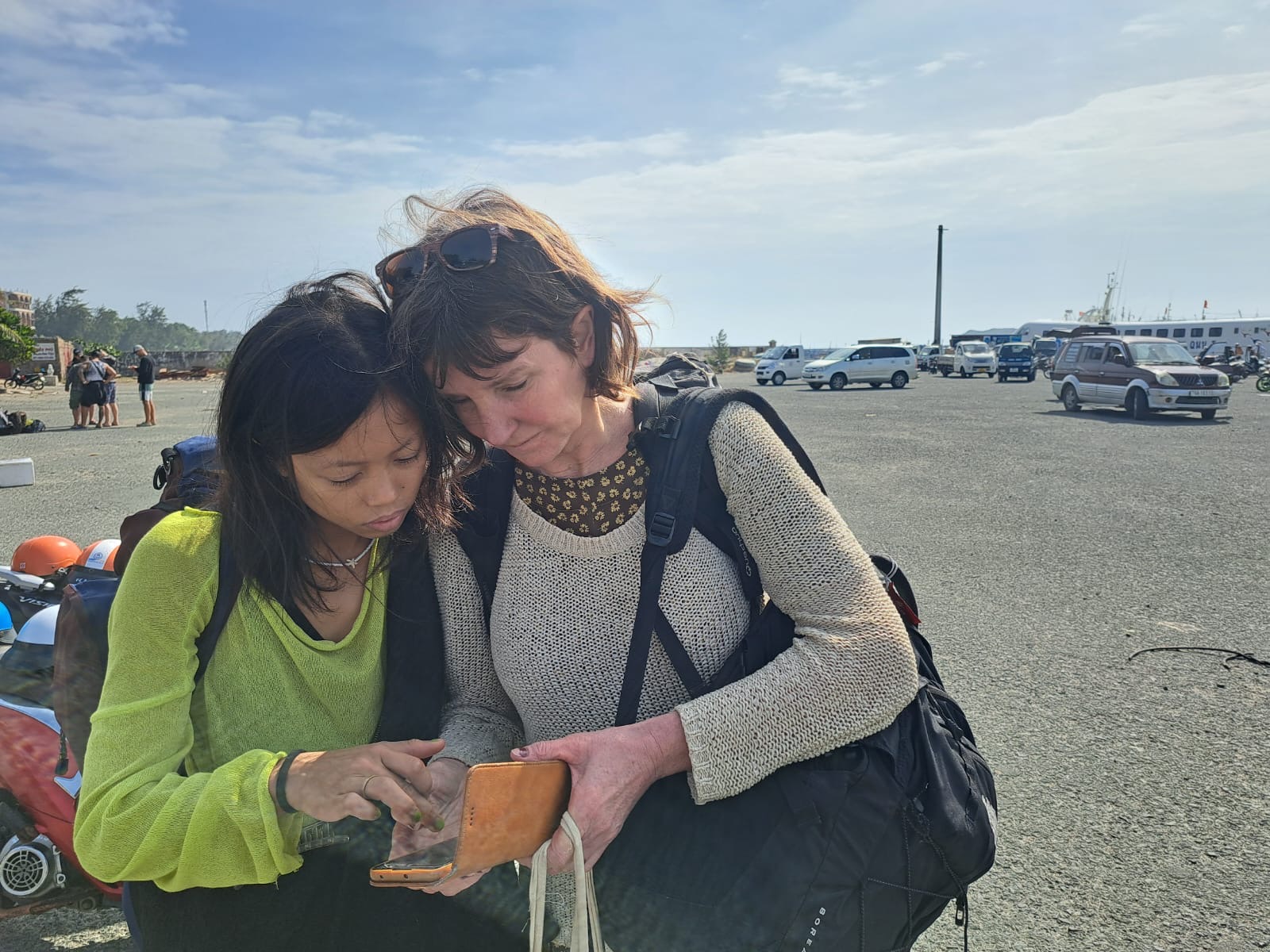
Hannah shared her thoughts with her Belgian adoptive mother, who said: “Hannah, you have to understand that your life is very different from your birth mother’s. Perhaps she does not fully understand, so she does not know what to say.”
After that, Hannah began to see things differently and stopped feeling sad. She only hopes her birth mother understands her a little better, while also accepting that they live in two different worlds, with no one at fault. The most important thing is that they care for and love each other. In this situation, perhaps that is ideal. Even more, Hannah’s two mothers care about each other. They often ask about one another and rely on Hannah to send messages. For Hannah, it is a very beautiful triangular relationship.
Two films about adopted children’s search for roots and identity helped Hannah see herself: “Léon: The Professional” by director Luc Besson and “Return to Seoul” by director Davy Chou.
In “Léon,” little Mathilda loses her biological family and finds refuge in Léon, a solitary hitman. Their relationship is not a traditional parent-child bond, but it is a deep connection between two wounded people learning to love and protect each other. Mathilda does not seek her biological parents, but finds a spiritual father figure in Léon, someone who helps her face pain and grow. In “Return to Seoul,” Freddie, a Korean-born girl adopted by a French family, returns to Seoul to find her birth parents. The reunion with her father is tense, and her mother refuses to meet. Freddie does not find clear answers to “Who am I?” but the journey helps her face herself and resolve inner conflicts.
Indeed, we humans, especially in Hannah’s situation and other adopted children, do not always find completeness. But each person can learn to live with unfillable gaps, and sometimes those gaps become the starting point of growth.
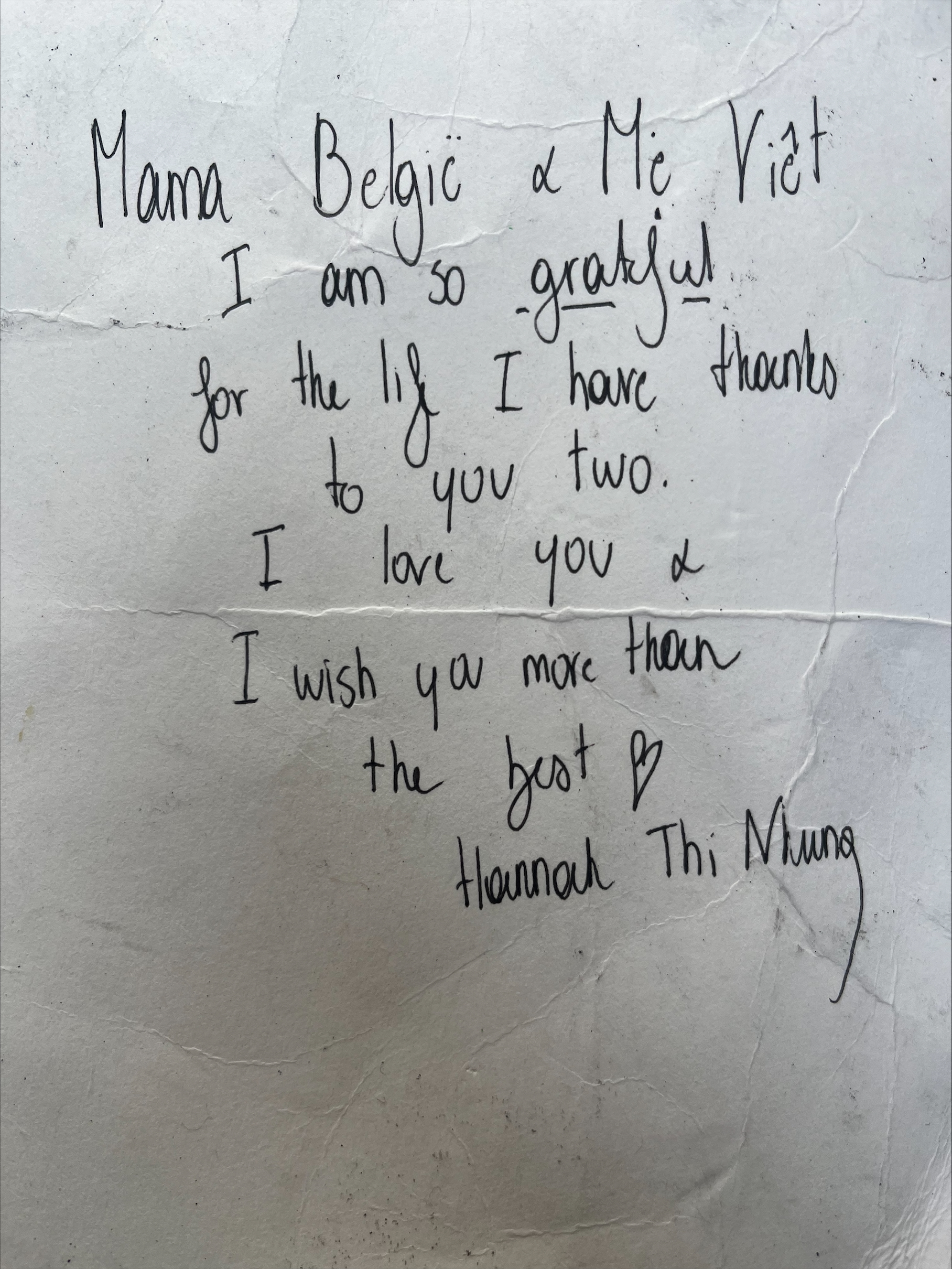
Finally, Hannah says: “What I want to tell both my mothers is that I love them very much. I am so grateful that both mothers contributed to making me who I am today. I truly wish them happiness.”
FEATURE: THE THINGS MOTHER HAS NOT TOLD
A New Zealand writer once said that he only truly understood his father after his father’s death, when he accidentally found an old diary. The words revealed parts of life he had never heard about. From there, he began to wonder about his mother, but she was gravely ill and no longer had the strength to speak all that remained unsaid.
The relationship between parents and children is strange, very close yet sometimes vast as the sky. “The Things Mother Has Not Told” is for those silent spaces, with three stories that are three slices of motherhood, where words are not always the only way to express love.
Originally published in Đẹp Magazine, Issue 301
Photography: Hannah Gellens