
Khoa Phung: A Love for Ornate Details
I first heard of Khoa through a friend’s introduction, and couldn’t help wondering: How deeply must a young person love Vietnamese culture to devote all their time and energy to researching, exploring, and breathing new life into artistic products that have gradually faded with time? I found myself eagerly anticipating the chance to meet Khoa, to sit down and talk, and to better understand the quiet yet beautiful force that drives him from within. Khoa Phung is a rather private figure; everything I knew about him then was formed solely through my own impressions while contemplating his works. We arranged to meet during a brief visit he made from Phan Thiết back to Saigon to see his family. More than a year ago, Khoa decided to relocate his life and creative practice to the coast. Though no longer living in a dynamic city and facing certain everyday inconveniences, this change of environment has offered him far more favorable conditions for creation: a sense of privacy, a cleaner climate, and a calmer state of mind—allowing him the time and space to linger with his thoughts and bring his ideas fully to life.

Khoa Phung’s lacquer paintings vividly articulate the artist’s enduring fascination with the beauty embedded in Vietnamese tradition and culture. The central figures in his works seem to step out of history books and ancient tales: women dressed in Nguyễn-dynasty attire, a group of Red Dao people in a highland wedding ceremony, a family wearing white headbands at a funeral, Mỵ Châu, the Moon Palace Deity Nguyệt Tịnh Công Chúa with her eight celestial attendants, or the Thanh đồng, ritual assistants, and musicians of Đạo Mẫu folk belief, among others. Through a fresh visual language—expressed in line work, color, and composition—Khoa infuses these age-old values with a renewed, vibrant vitality.
Beyond lacquer painting, his signature medium, Khoa Phung harbors a deep passion for continuously exploring new ways to reinterpret traditional art through a distinctly personal lens. One notable project is the Twelve Noble Maidens series, exhibited at the “Happy New Tết” event in Australia. Drawing inspiration from Disney princesses, the series reimagines them in the traditional costumes of Vietnam’s ethnic groups from North to South, developed on the foundation of the Tố Nữ genre in the style of Hàng Trống folk painting. Another project focuses on revitalizing Đông Hồ and Hàng Trống folk paintings on giấy điệp, employing techniques and forms that closely align with the original artistic values of these traditions, while refining costume designs to more accurately reflect authentic Vietnamese dress rather than the generalized attire often seen in classic Đông Hồ imagery.

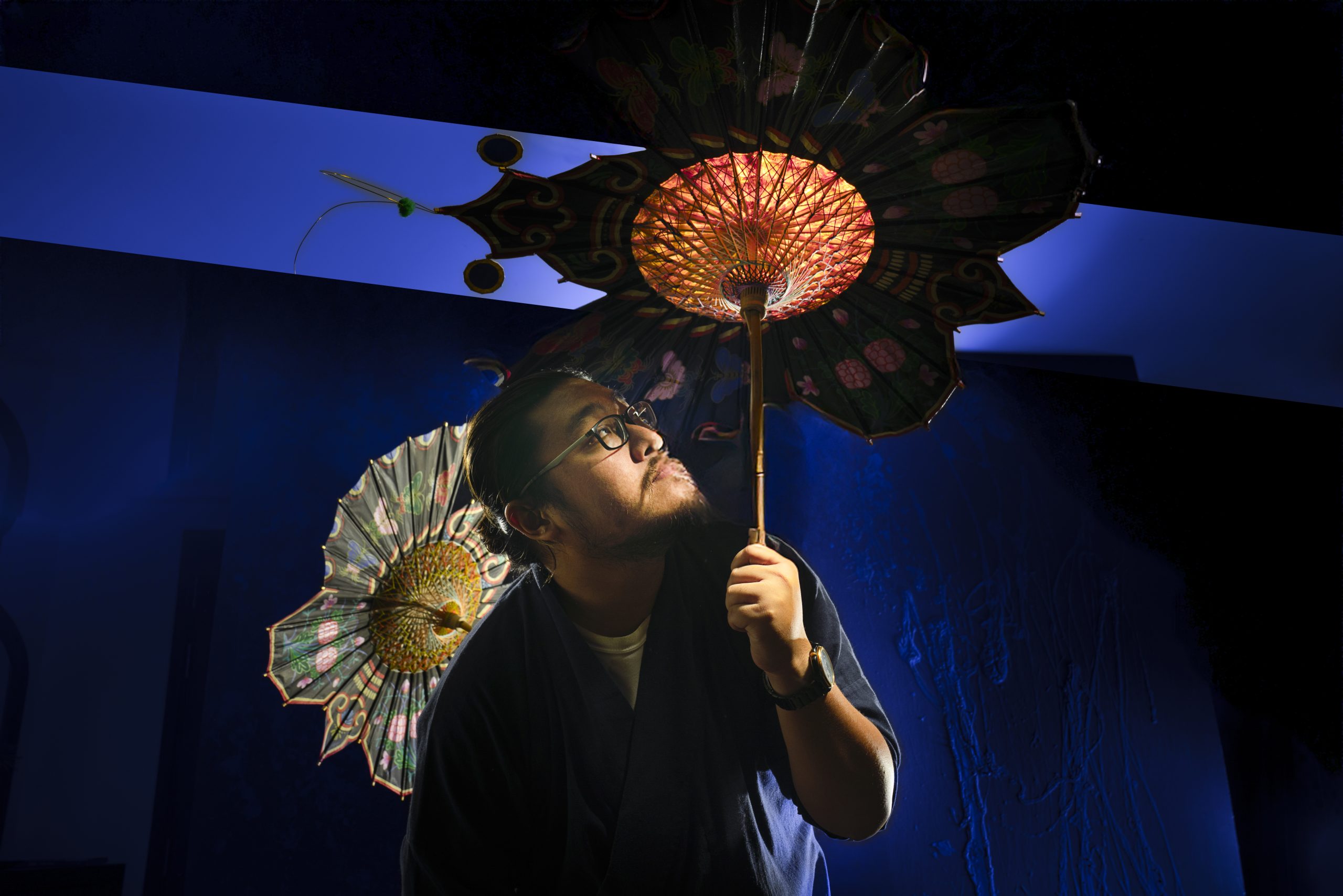
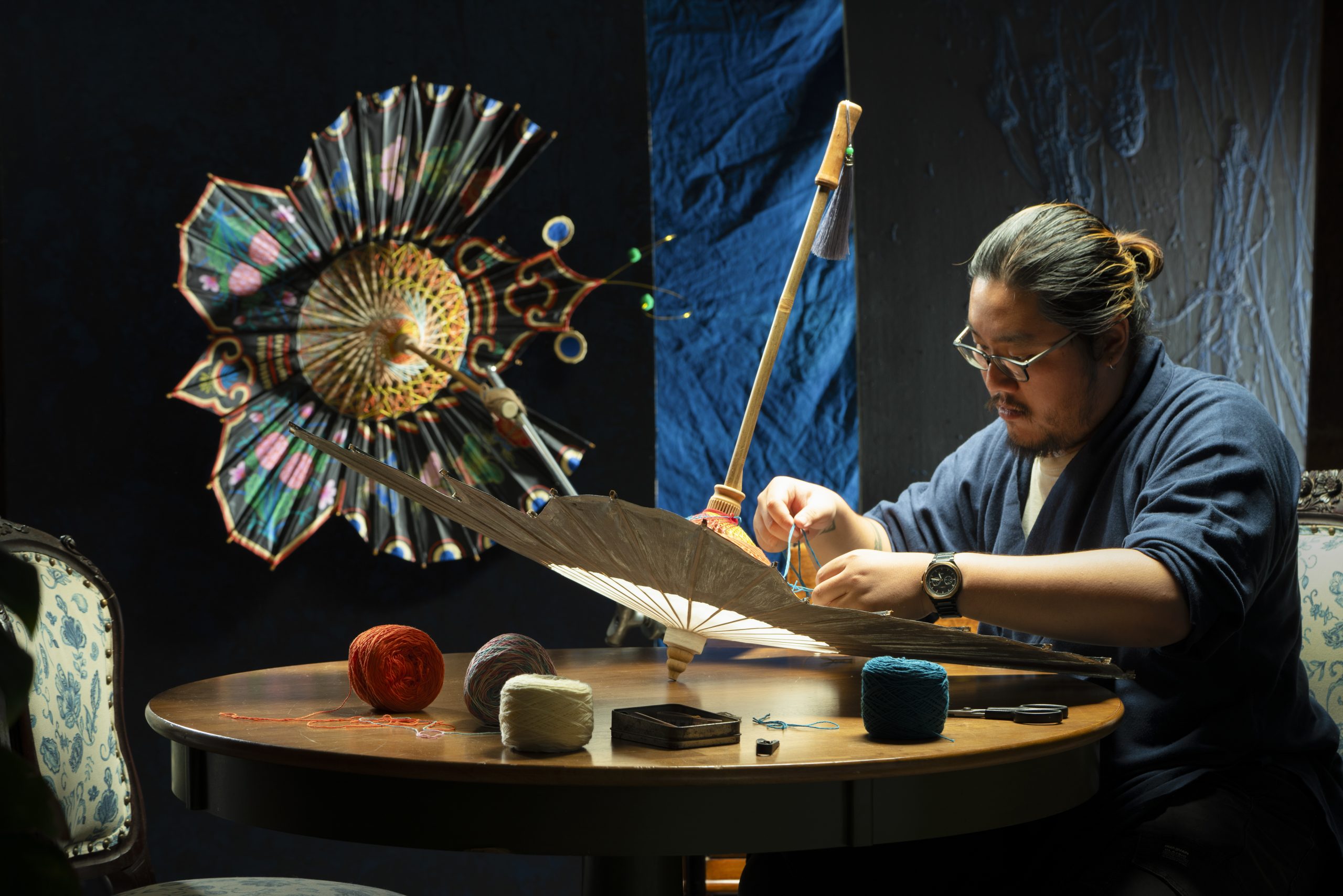
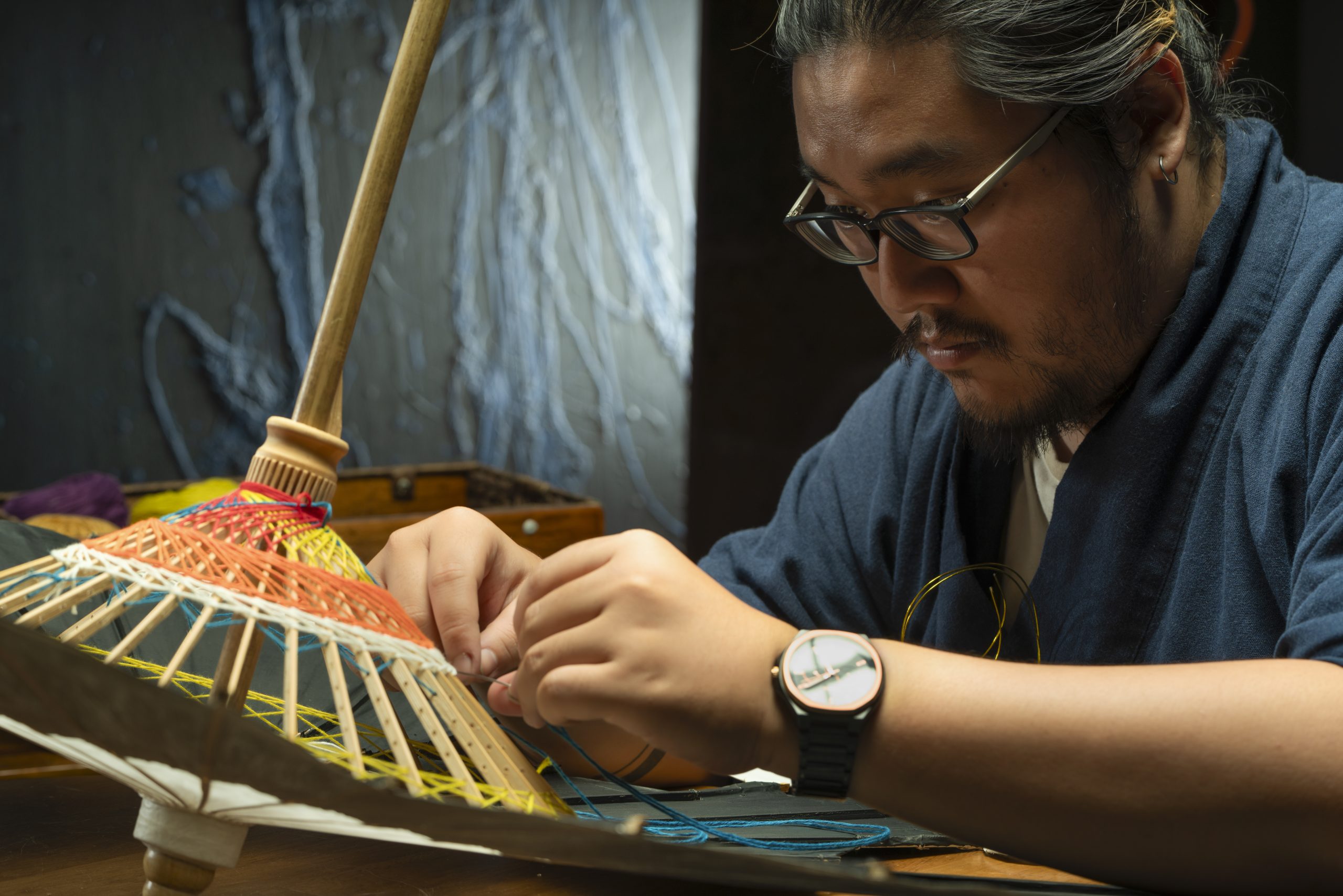
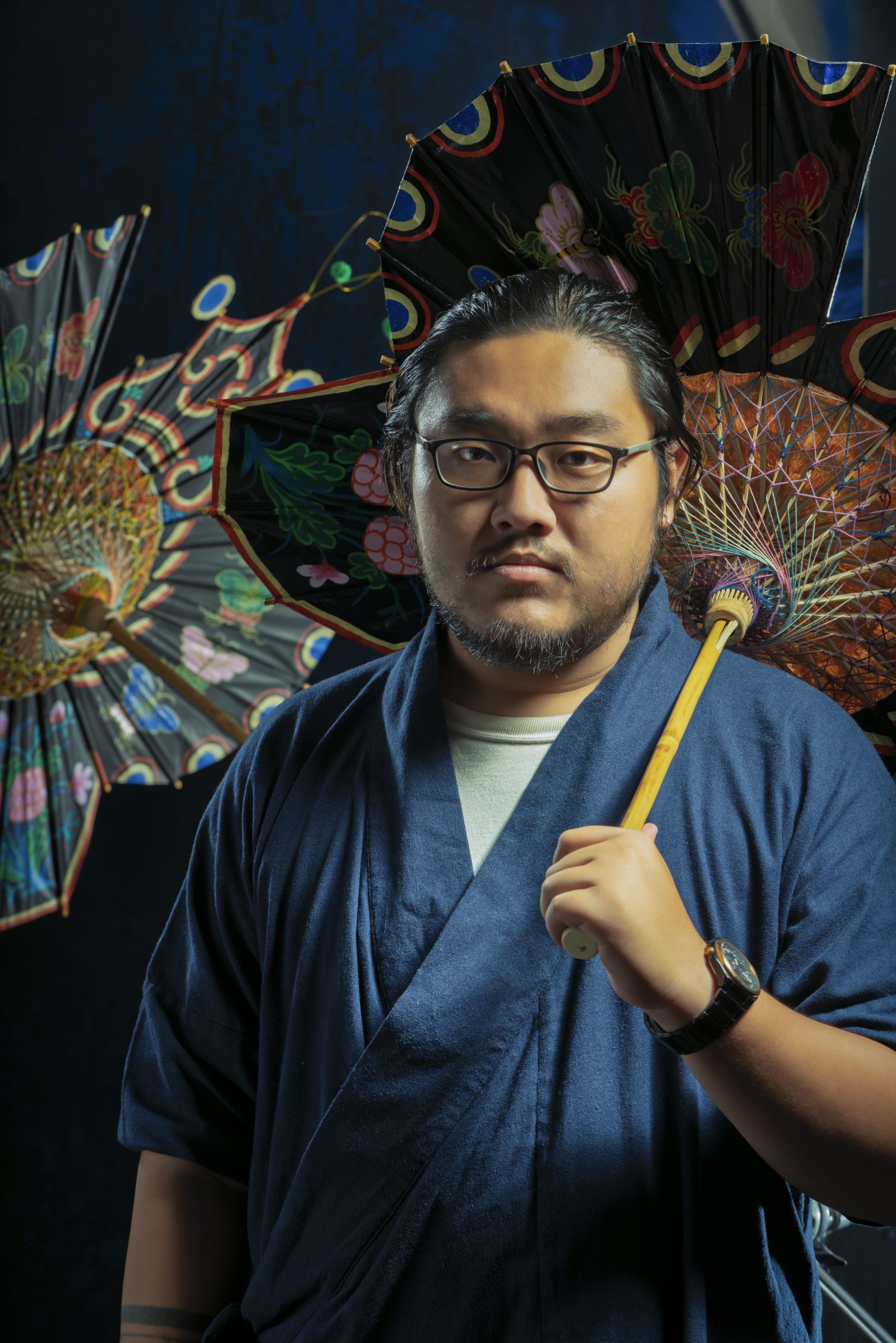
Recently, Khoa Phung has been researching and reconstructing lọng bướm—butterfly parasols—an ancient cultural symbol of the Vietnamese that has gradually faded with time. The process of recreating a butterfly parasol is exceptionally meticulous, involving multiple stages: cutting and pasting, sewing the edges, weaving decorative cords, hand-painting motifs, and applying a waterproof oil coating. Completing all these steps takes approximately ten days. Through this painstaking process, Khoa Phung reveals himself as a true perfectionist—fully absorbed, precise, and patient in every smallest gesture. Reimagined through his own distinct sensibility, these once-forgotten butterfly parasols have unexpectedly transformed into stylish objects coveted by fashion-forward youth both in Vietnam and abroad. Their renewed presence affirms a timeless belief: that time has its own way of filtering out imitations of beauty, only to bring genuine beauty back into the light.
Why did you choose to major in lacquer painting instead of another fine arts discipline?
I decided to pursue lacquer painting rather than other materials because I felt a deep personal connection to traditional values. Moreover, lacquer is a medium that carries a distinctly Vietnamese identity. To me, it presents both significant challenges and vast possibilities for exploration. The challenge lies in creating works that remain deeply rooted in the Vietnamese national spirit without falling into well-worn paths. It is precisely this challenge that opens up opportunities for me to experiment freely—so that the Vietnamese essence within my works can feel genuinely fresh within the contemporary flow of art.
It is evident that your artistic practice reflects a strong affection for and concern with traditional values. What do you find most compelling about Vietnamese painting in particular, and Vietnamese art in general? How do you apply what you learned in school to your creative practice?
What I find most compelling about Vietnamese art is its long and rich history, shaped by both shared characteristics and striking differences among the cultural regions of our 54 ethnic groups. Even the absorption of influences from Chinese culture and French art has contributed to a uniquely multifaceted Vietnamese artistic landscape. The knowledge I gained through formal education has provided me with a solid, systematic foundation in composition, color, and an overall understanding of materials. This grounding allows me to apply what I’ve learned effectively in my creative process and to work confidently across a wide range of artistic media in practice.

What inspired your idea to reconstruct the butterfly parasols?
Very little documentation of ancient Vietnamese parasols has survived to this day. On one occasion, I came across an illustration of a butterfly parasol in Technique of the Annamites by Henri Oger. Later, I learned about a butterfly parasol being auctioned in France—one that had endured many years of obscurity. Although it was no longer intact, it provided me with enough concrete visual clues to form a clearer understanding and establish directions for further research and reconstruction. Initially, I pursued this work purely out of personal interest, never imagining that it would reach or resonate with so many people.
You mentioned that everything you do stems from personal passion. How has your love for art grown over time?
Although I did not come from a family with an artistic background, the richness of my family’s context allowed me to encounter diverse cultures from the North to the South of Vietnam. This exposure helped me realize at a very early age just how varied and abundant our country’s culture and art truly are. However, merely learning through books or secondhand stories is never enough. My passion gradually deepened through direct experience—through each place I have traveled to. Every location offers its own perspective on art, and through those lived encounters, I have been able to learn and absorb far more through practice and firsthand observation.

It seems that a visual artist like yourself needs extensive real-life experience—both as a source of inspiration and as a way to broaden professional knowledge. Could you elaborate on your personal perspective on art, and on what you have learned while traveling across different regions of Vietnam?
Traveling extensively has allowed me to acquire a wide range of knowledge. Field trips help me verify what I once encountered only in books. There are things I had never known before, and there are also things I thought I understood, only to realize that cultural practices in different regions evolve over time while existing documentation may not have kept pace with those changes.
For instance, if I had relied solely on books, I would have known bronze drums merely as Đông Sơn–era artifacts and assumed that they were no longer in use. In reality, that is not the case. In Vietnam, several ethnic groups such as the Khơ Mú, Pu Péo, Lô Lô, and Mường still use bronze drums in ritual contexts. One particularly fascinating detail I observed during a trip to a Lô Lô village in Hà Giang was that their pair of bronze drums—male and female—are usually buried underground, and only unearthed for funerals, weddings, or Tết celebrations.
On another occasion, while attending a funeral in Kon Tum, I learned of a local custom in which the deceased, after being dressed, is also given a mourning headband. The explanation is deeply symbolic: the deceased, too, has lost their parents, and thus must still observe mourning in order to fulfill filial piety. When I attended the Kate Festival of the Chăm people in Ninh Thuận—their traditional New Year—I had the chance to share a meal with a local family. I was surprised, as I had always assumed that followers of Brahmanism would not eat beef. Yet beef was served at the meal. Upon asking, I learned that today attitudes have shifted: only religious dignitaries are required to observe strict dietary prohibitions, while ordinary people tend to be more flexible.
As for the H’Mông, clothing holds profound importance. Every Tết, they must have new garments to wear, as wearing old clothes is believed to bring misfortune. For this reason, they typically spend half the year farming, and the remaining time cultivating flax, extracting fibers, weaving, and dyeing cloth. Whenever there is spare time, women sew and embroider in preparation for new outfits for the entire family. In households with older daughters, the girls are taught these skills early to help their mothers. This is also why most brocade textiles on the market today originate from the H’Mông. Today, however, perspectives have become more open. Cooperative weaving groups have emerged, enabling year-round production, and allowing women greater freedom—no longer confined solely to farming and seasonal garment-making for their families.
You’ve mentioned that you are particularly drawn to researching artworks that have faded into obscurity. Could you share some of the fascinating discoveries you’ve made through this process?
Perhaps because contemporary tastes increasingly favor minimalism, ornate and elaborate forms have gradually fallen out of favor, and there are not many people today devoted to reconstructing them. I, on the other hand, am someone who delights in intricacy and excess. I love working from scattered historical materials to find ways to bring highly aesthetic objects—those deeply intertwined with cultural values—back into modern life. What I find most rewarding in this research process is the opportunity to engage with people from many different fields connected to whatever I am studying at the time, which in turn opens up new perspectives on various facets of art.
My research mainly focuses on painting, sculpture, handicrafts, and costume. There is a wealth of in-depth scholarship on traditional culture and art, and through reading and studying these materials, I’ve come to realize just how imaginative people in the past were—and how consistently they aspired to create objects that were complex and richly detailed. At present, I am researching the reconstruction of a type of nón lá once worn by court officials, covered with crow and stork feathers. Depending on rank, the hat’s color and the design of its finial would vary. I am also studying tranh gói vải, a form of fabric-wrapped painting that was popular in Central and Southern Vietnam toward the end of the Nguyễn dynasty, primarily used for devotional portraits and religious imagery. My aim is to further develop this genre by expanding its subject matter, so that it may exist beyond purely ritual or worship contexts.
Why do you often describe your work as “reinterpretation” or “reconstruction” rather than “restoration”? When weighing the preservation of an original work’s spirit against the assertion of personal expression, which side carries more weight for you?
At this point, I do not feel confident enough to call what I do “restoration.” I prefer the terms “reconstruction” or “reinterpretation,” because true restoration requires a tremendous amount of technical mastery and in-depth research in order to recreate an object as faithfully as possible to the original. With the butterfly parasols, I believe my work currently achieves about seventy percent fidelity to the original forms.
I spend a great deal of time thinking about how to preserve the essential elements—the very character and spirit of the original object—while simultaneously finding ways to refine and adapt it to suit contemporary tastes. From there, I continue researching and developing materials that are most appropriate for bringing the work to life. With the butterfly parasols in particular, I intentionally introduce my own creative touches in color and pattern, making them more approachable and easier to embrace. Only then do these objects have a greater chance of truly living on.
Fashion seems to be a defining element in your work—from painting to butterfly parasols and feathered hats. Perhaps this is why your works resonate not only with professionals, but also with style-conscious, art-loving young audiences?
I consciously weave fashion deeply into my work because, to me, clothing is the most fundamental element through which viewers can identify which ethnic group a figure belongs to. In this way, people can more clearly perceive the beauty and cultural diversity of Vietnam’s many communities, and distinguish Vietnamese ethnic identities from those of groups in China, Laos, Thailand, and beyond—rather than flattening them all into vague notions of “ethnic minorities,” “ethnic brocade,” or “folk patterns.” This diversity is precisely what I cherish about Vietnamese culture and art. I do not subscribe to the idea of a single Kinh majority set against an undifferentiated “rest.” Instead, I want audiences to see and appreciate the distinct beauty inherent in each ethnic group.
In recent years, artistic practice in Vietnam seems to have become more open: artists increasingly blend different art forms, and the practical application of art in everyday life has been elevated. What have you observed within this flow? Do you believe that new creations grounded in traditional foundations are more sustainable?
Sustainable values lie in the depth of history and culture. New creations, over time, will themselves become old, and may eventually no longer suit future societies. That is why cultural products must increasingly learn how to inherit and develop from what came before.
As I mentioned earlier, contemporary society seems to be gradually losing a certain sense of fascination, largely due to industrialization and its close association with minimalism. Yet convenience can still coexist with beauty, if there is genuine intention. Objects such as vintage butterfly sewing machines or record players still possess strong aesthetic value—qualities people continue to admire today. They do not disappear in the flow of history, but rather live on alongside social development. In that sense, intricacy can absolutely coexist with modern life, as long as it is beautiful enough.
I also see a positive shift in how society today engages with art—more actively, more dynamically. This, in turn, creates motivation and inspires artists in general, and myself in particular, to be more daring and energized in our creative pursuits.
Thank you for the conversation!
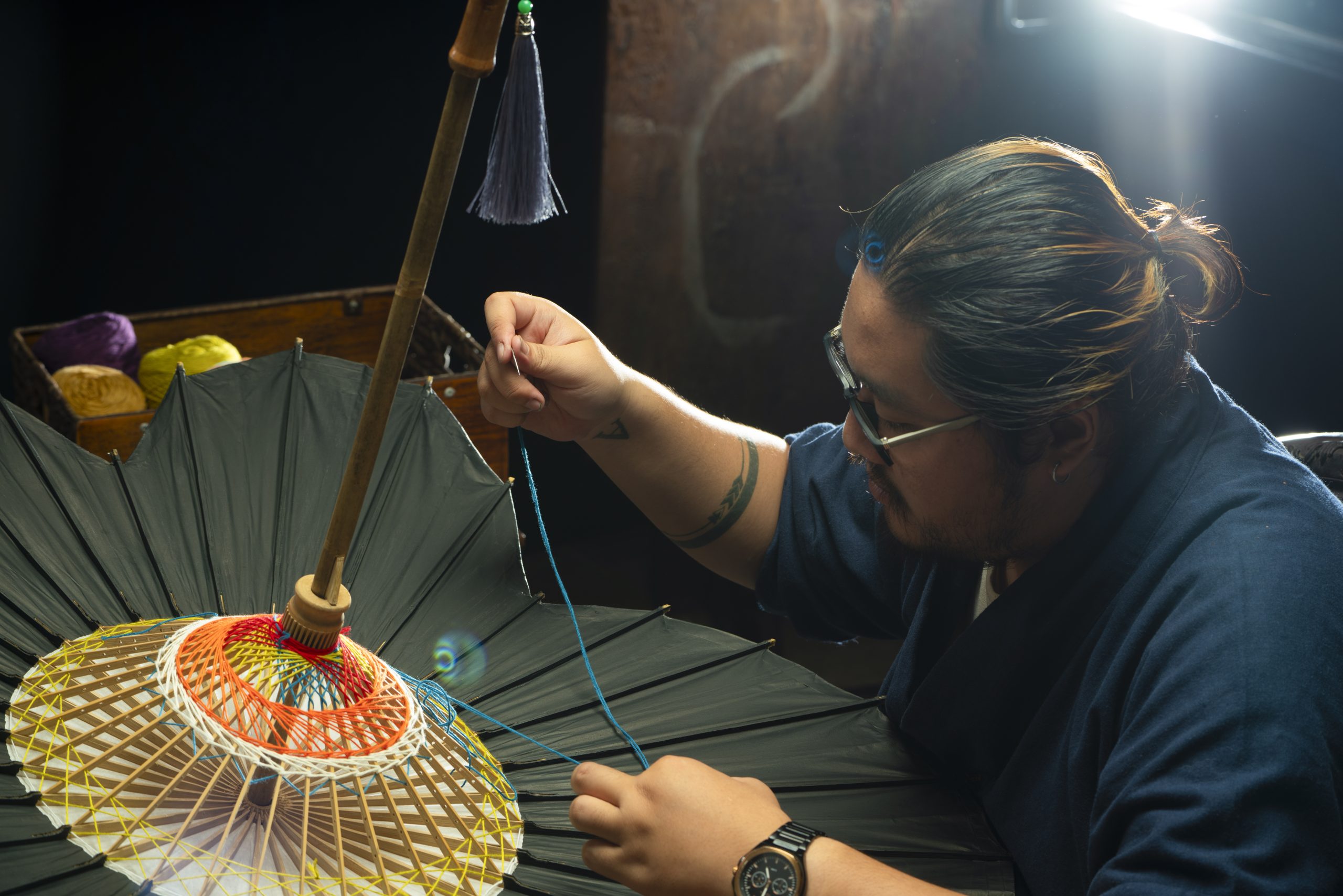
According to historical records, the butterfly parasol was a handcrafted product created by the skillful hands of artisans from traditional Annamese parasol-making villages. Envoy Lê Công Hành (during the reign of Lê Chiêu Tông) is regarded as the founding father of parasol-making and embroidery in Vietnam, having learned these techniques while on a diplomatic mission to China. In Connaissance du Việt-Nam (Understanding Vietnam), published in Hanoi in 1954, Pierre Huard and Maurice Durand noted that sun parasols were symbols of political power or social status, used either for shade or as decorative objects displayed in the homes of elite families.
Originally published in Đẹp Magazine, Issue No. 292
Photo: Ngọc Ánh


