Nguyễn Ngọc Tuấn: Walking Between Two Timelines
Years of studying literature and translation–interpretation in France, along with an extended career in Franco–Vietnamese cultural exchange, gradually nurtured Nguyễn Ngọc Tuấn’s deep passion for the arts. After more than a decade of dedicated self-study and exploration in painting, he presented his first solo exhibition, 1×2, marking a significant turning point in his creative journey. His recent works represent a renewed dialogue with East Asian ink painting and calligraphy, forming a distinctive and contemporary visual language through abstract and semi-abstract expression. Working with gouache, ink on paper, and a wide range of materials, Nguyễn Ngọc Tuấn creates artworks that feel both meditative and experimental—quietly bridging past and present in a uniquely personal way.
The Habit of Self-Education
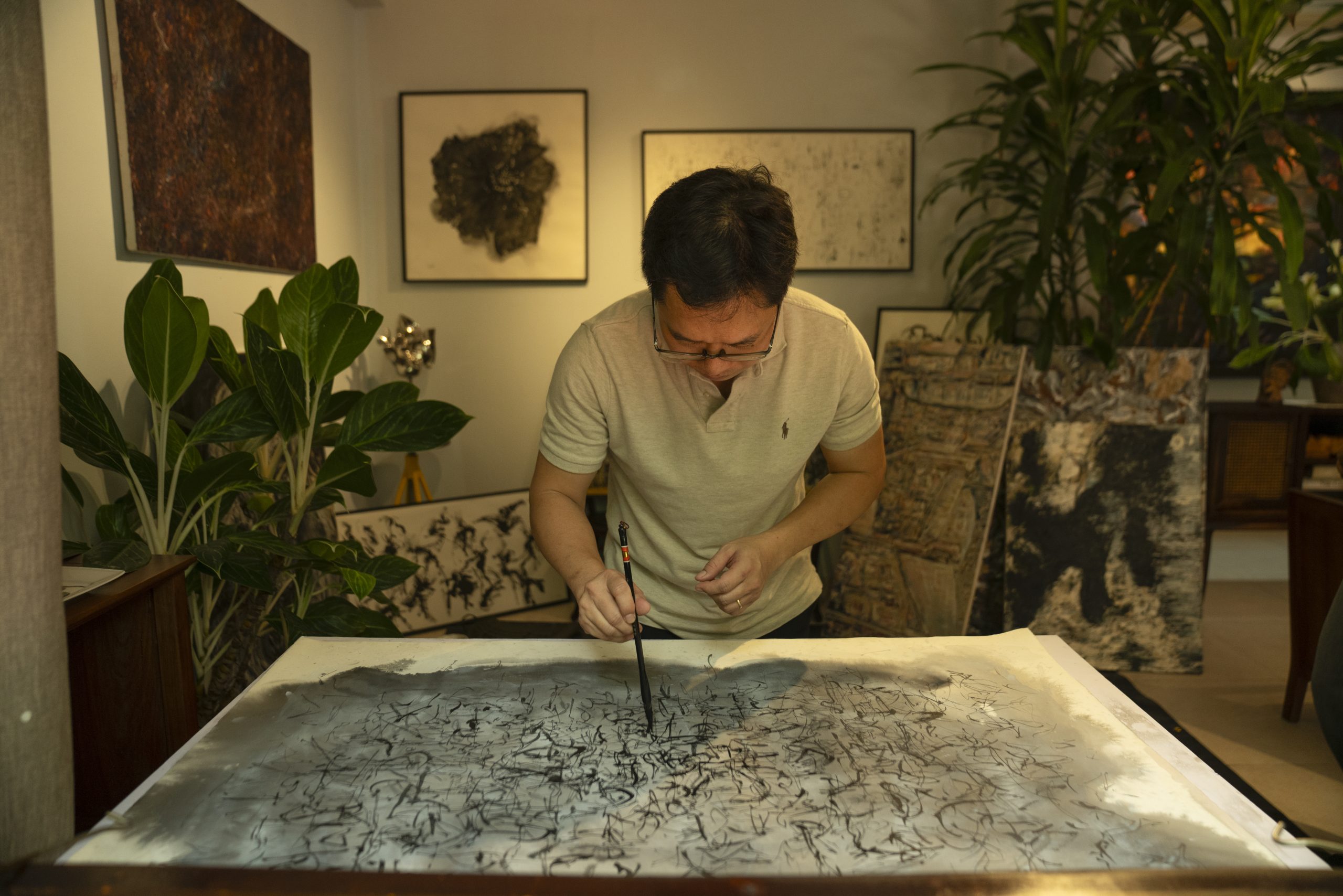
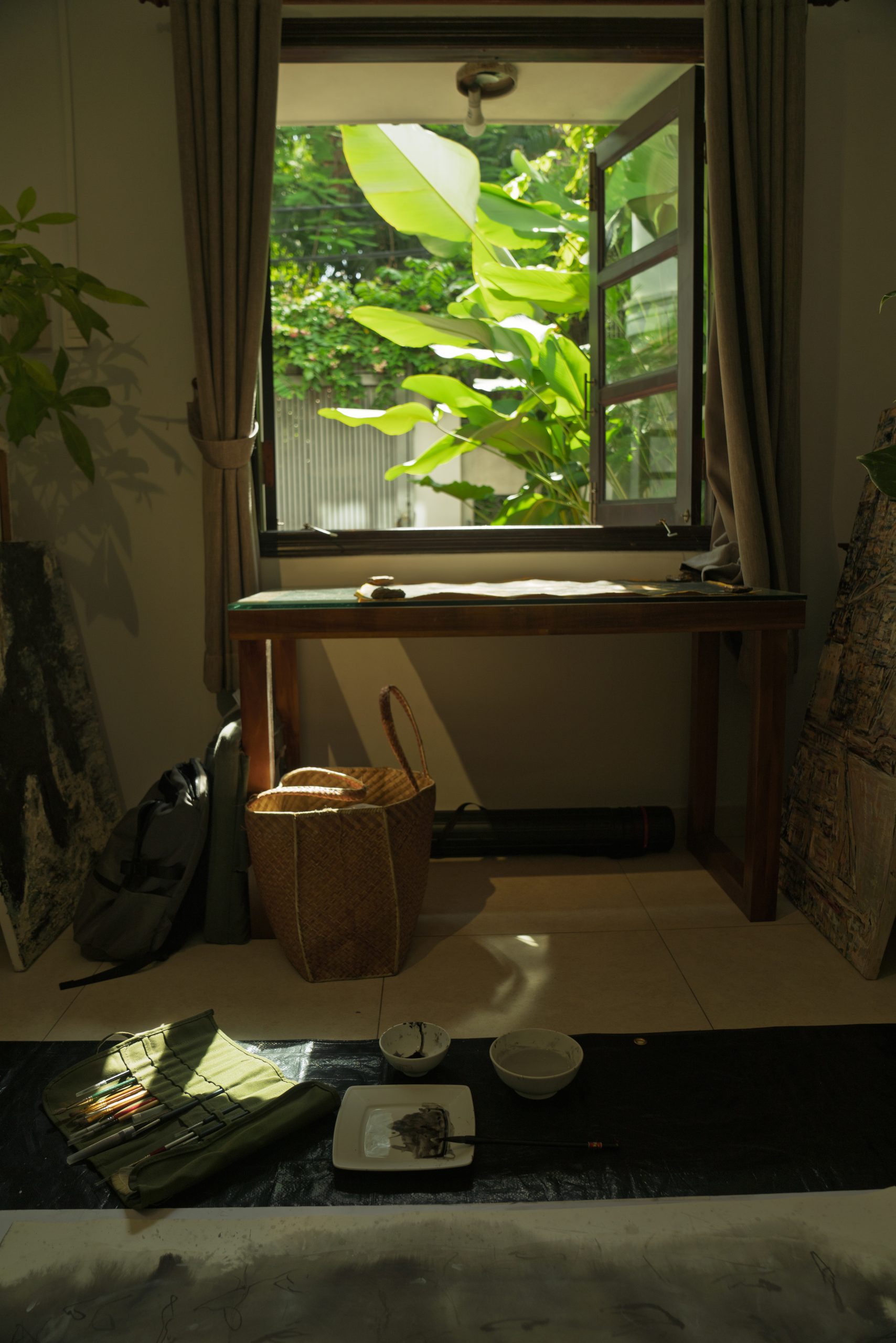
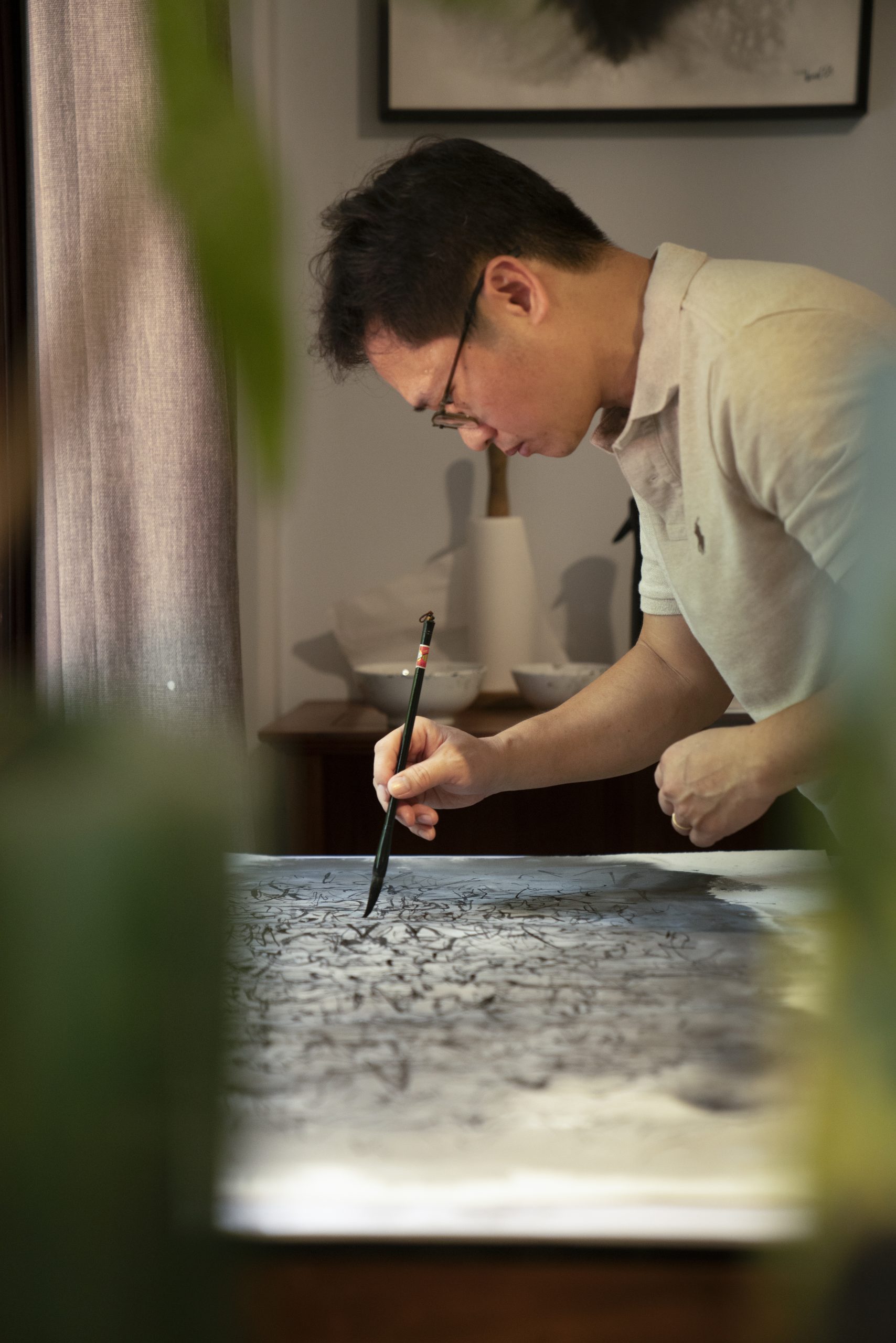
Nguyễn Ngọc Tuấn’s paintings left a strong impression on me with their restrained monochromatic palette, lines that are at once supple and resolute, and ideas that hover between concealment and revelation—above all, a quiet elevation of the beauty found in decay. I expressed a wish to visit his place of creation, and he later invited me to a well-appointed house with a sunlit courtyard, its interior lined with paintings he had made. I learned that most of his works are gifts for close friends. In a small corner of the living room sat a half-finished painting alongside a few basic tools; the floor was covered with fabric to protect it from stray paint. I was slightly surprised when he told me that he does not have a fixed studio space. Each time he paints, he simply sets everything up in a corner of the house; once the work is finished, he tidies it all away, restoring the home to its everyday state.
Speaking of his path toward painting, Ngọc Tuấn shared that his spirit of exploration may have been shaped by two people. The first was his maternal grandfather—whom he never met, yet often heard described as a man who taught himself many different things. The second was his father, an exceptionally accomplished student, who frequently spoke about the importance of independent learning. While studying at the University of Social Sciences and Humanities, he chose a graduation thesis that examined the intersection of painting, poetry, and music in the nineteenth century. Although his engagement at the time was purely theoretical and not yet practical, the research nevertheless required him to delve into the world of visual art. After graduating, he worked at the French Consulate General in the cultural exchange department, where he participated in numerous cultural and artistic exchange activities, served as an assistant to the cultural attaché, worked as a translator, and helped organize exhibitions. These experiences quietly ignited his passion for painting without his even realizing it. Around twelve to thirteen years ago, he made the decision to teach himself how to paint. He purchased numerous books and learned through online platforms. His very first painting was a small work depicting the ancient streets of Hội An. At that time, as a self-taught artist, he was influenced by figures such as Bùi Xuân Phái and Monet. Looking back from that first painting to the present, he sees the greatest transformation in his growing boldness—both in his brushstrokes and in his expanded use of materials, ranging from oil and acrylic to ink, working on canvas and paper, and incorporating mixed media in his most recent exhibition.
For more than a decade, he has maintained the habit of painting every day, except during especially busy periods. In the evenings or on weekends, he always makes time to paint. His creative process often draws from a reservoir of ideas he has accumulated over time, thanks to his habit of jotting down compelling thoughts or capturing intriguing images while reading books or newspapers, browsing online, or traveling. Speaking about how he builds this personal archive of references, he shared: “There is so much in the world around us worth paying attention to—especially patches of moss. They resemble natural paintings, much like oil painting techniques with multiple layers. Time and nature have layered countless coats onto walls in Hội An, Huế, and the areas where I live. I often notice these details and find them incredibly beautiful. As I pass by, I photograph them and later use them as source material for abstract paintings.”
Inspiration from Eastern Art
In the past, the artist once believed that East Asian art was outdated and uninspiring. However, after coincidentally watching a film about a Chinese calligrapher and subsequently delving deeper into East Asian painting, ink wash, and calligraphy, he found himself swept up by a powerful new source of inspiration. During the Tang dynasty, figures such as Zhang Xu and Huai Su were renowned for their cursive script calligraphy. Each work of cursive script, in his view, resembles an abstract painting in its own right. He believes the saying “the writing reveals the person” is especially evident in calligraphy, as it vividly conveys the calligrapher’s character—whether refined and elevated, or bold and forceful.

This realization led him to understand that Eastern philosophy, painting, and calligraphy contain many profound and fascinating qualities he had previously overlooked—due largely to preconceived notions and a lack of understanding. He came to see that the true beauty of Eastern painting lies, first and foremost, in its underlying philosophy. Why ink wash? Why black and white? Why the presence of empty space? All of these elements embody Daoist thought. The second distinctive feature that sets Eastern painting apart from Western traditions is its approach to color. Black and white dominate, in part because Eastern philosophy tends toward restraint and simplicity. The third lies in the integration of poetry, calligraphy, and painting: the artist composes poetry and writes calligraphy directly onto the painting, uniting three art forms within a single work. There is a quote by painter Bùi Xuân Phái that he particularly cherishes: “One must read, must look, must study the great artists. They make us humble and help us move forward.” Inspired by these insights, he decided to draw upon certain materials and methods of the past to create works that are deeply Eastern in spirit, yet articulated through a new, contemporary form.
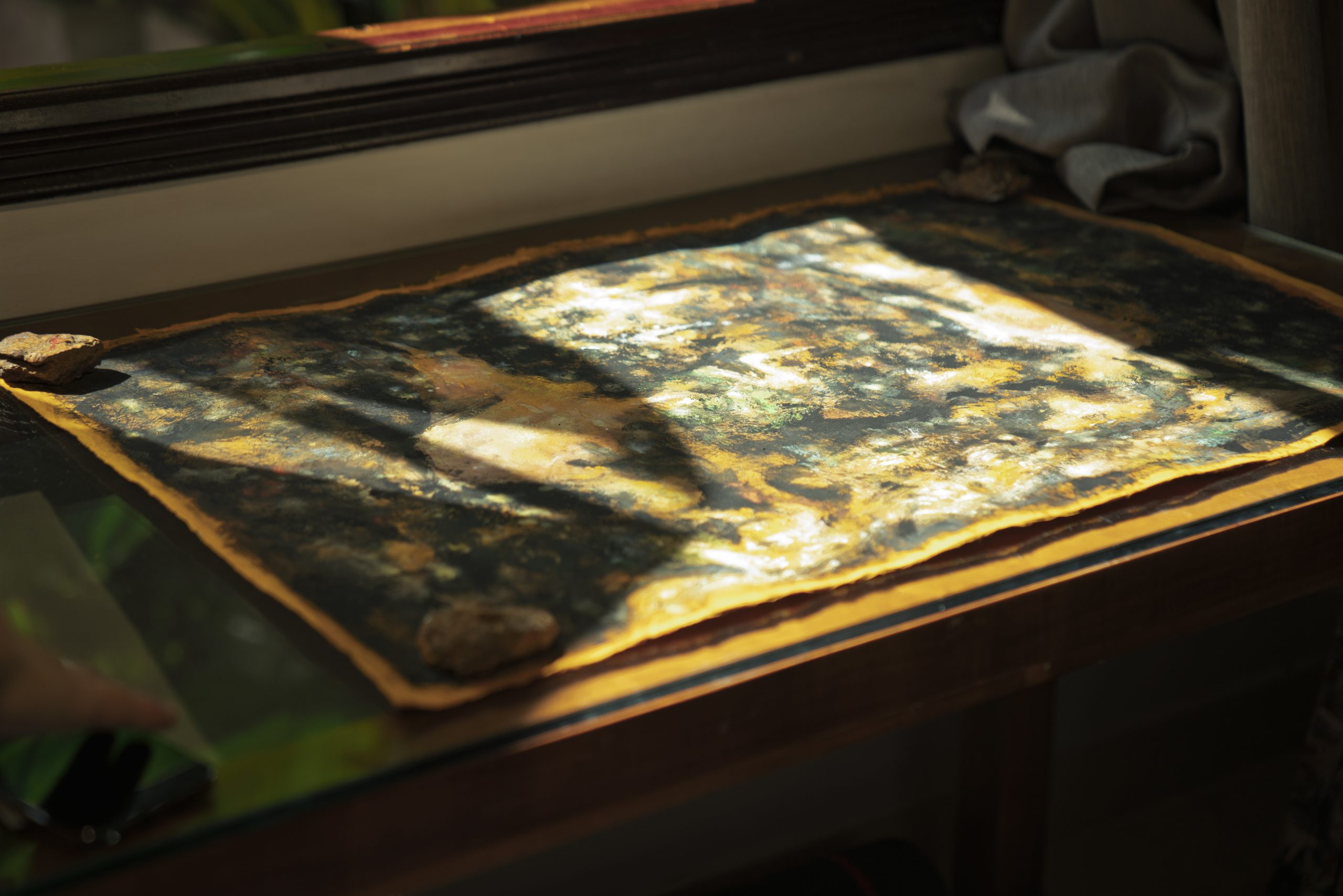
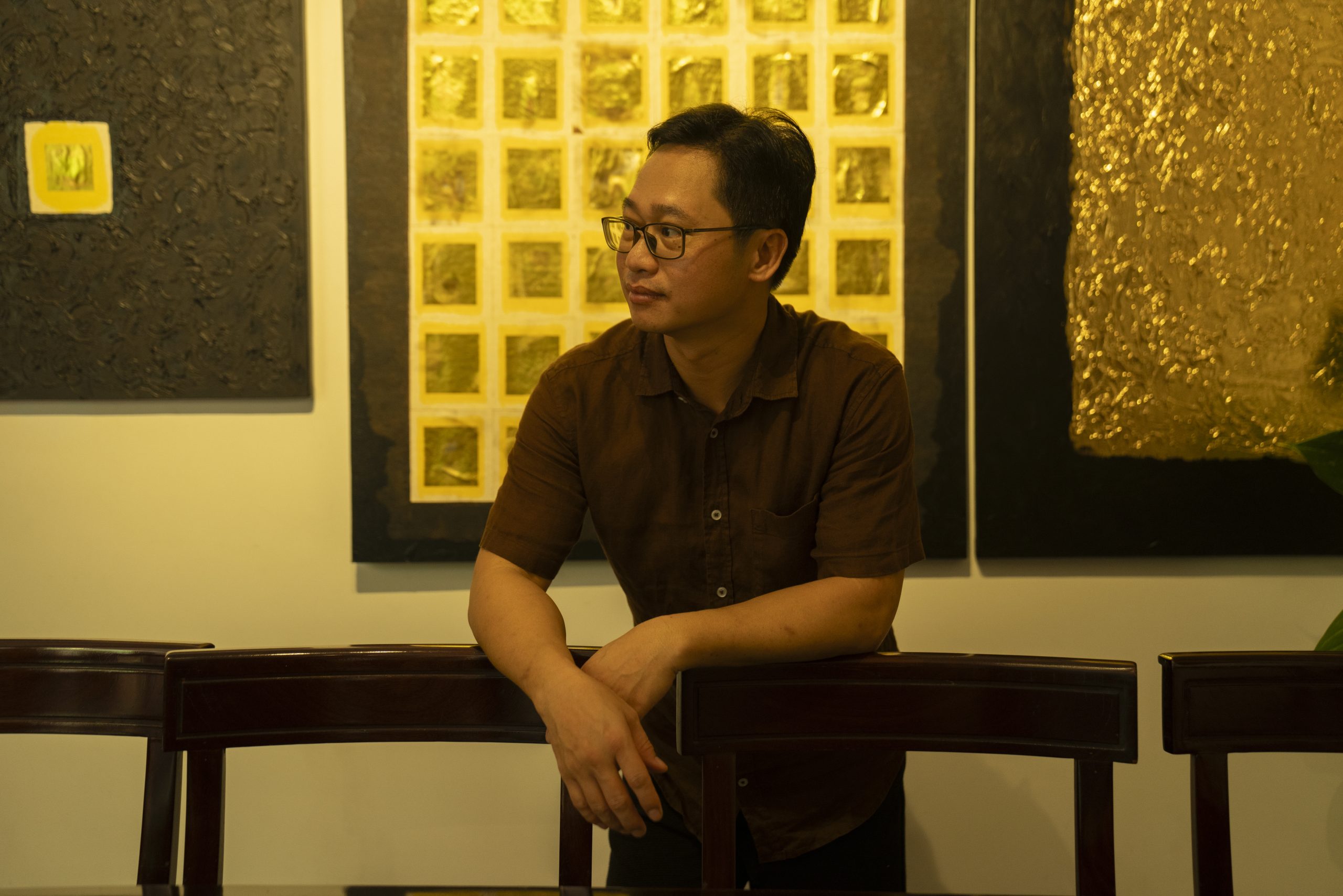
“In my most recent exhibition, there was a series in which I painted human figures in different poses using brush and ink, forming an abstract whole. There was also a series titled Gold, though the ‘gold’ here is actually vàng mã—joss paper. The idea came from the Vietnamese practice of burning joss paper, when families buy paper offerings to burn during visits to graves. My own family does this as well, and each time we burn joss paper, I find myself watching the flames and the paper, seeing them as something visually beautiful—almost like a painting. I photographed and filmed those moments. When I began experimenting with this idea, I first used handmade paper from ethnic communities, tearing and collaging it, then incorporating joss paper—sprinkling it onto the surface and painting over it. Some sheets of joss paper money were also burned, torn, and collaged directly onto the work. At present, I am experimenting with a piece that uses the natural folds of joss paper to form planes and volumes within the composition,” painter Nguyễn Ngọc Tuấn shared.
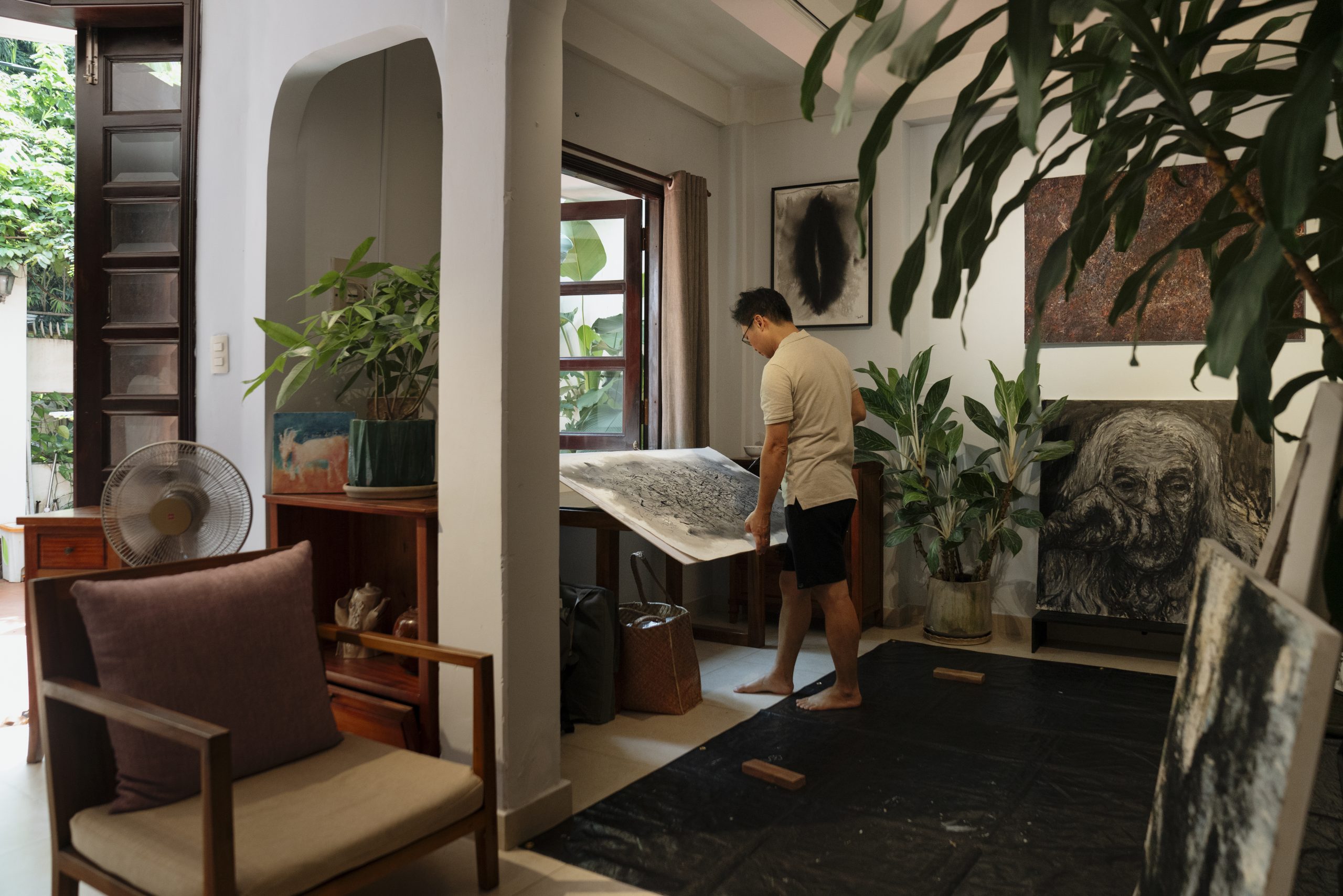
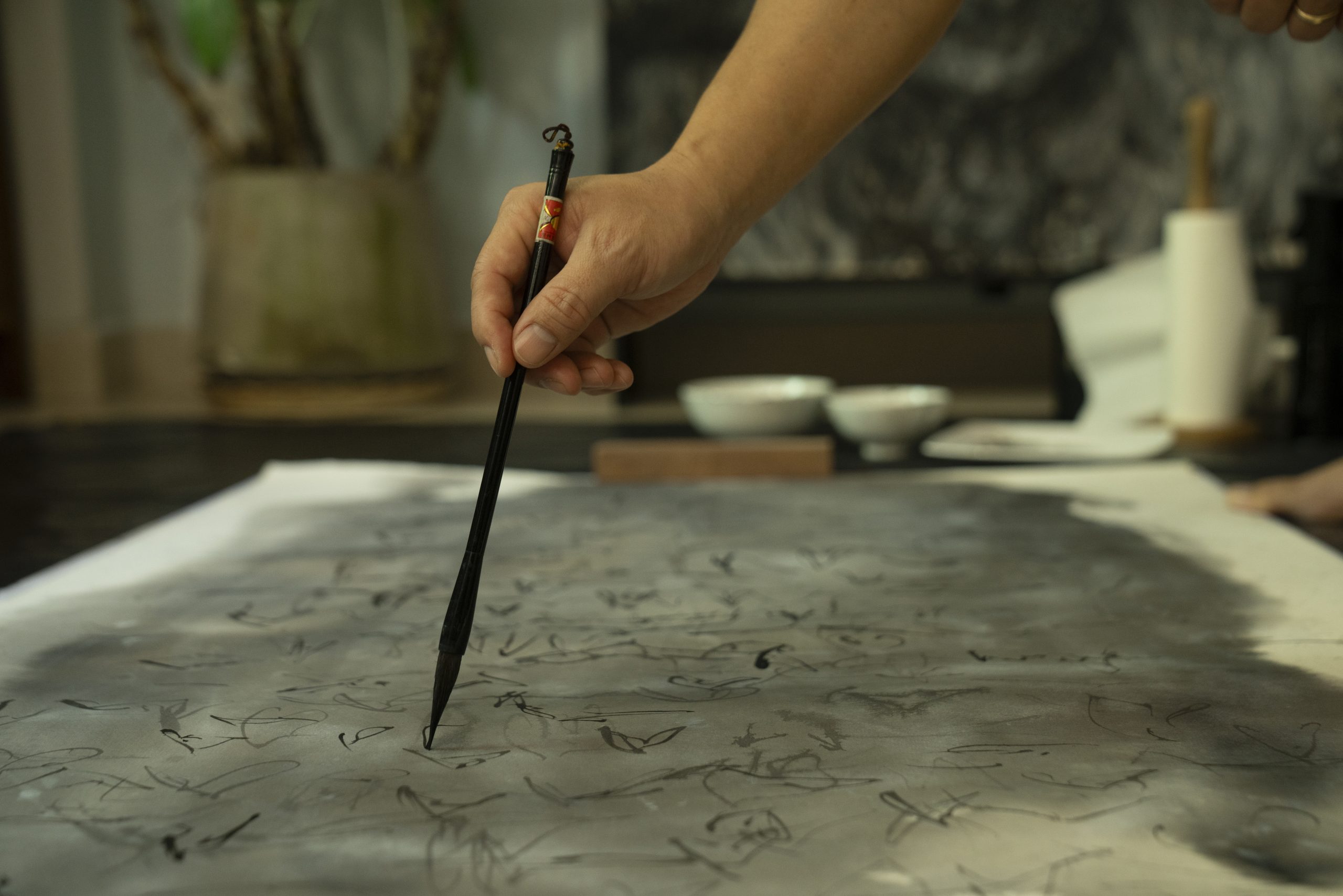
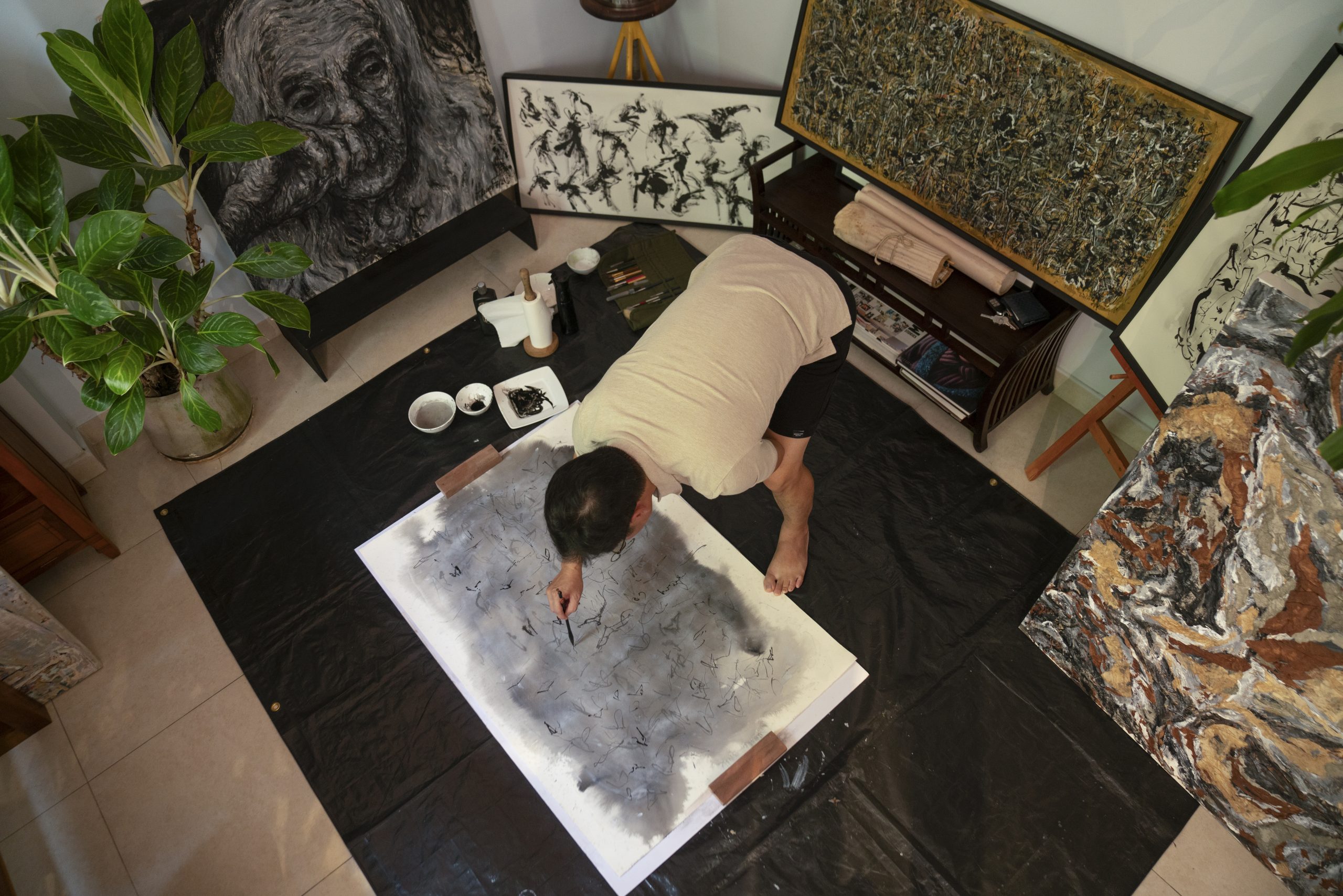
In a corner of his home hangs a painting depicting a withered lotus dance—graceful and spontaneous across the surface of a lake—formed from abstract cursive-calligraphy strokes. We also had the chance to watch the artist at work on another large-scale painting created in the same manner. When painting, he has a habit of playing a favorite playlist and letting his brush move freely with emotion, without overthinking each stroke. One by one, the silhouettes of fading lotus blooms emerge on the water’s surface, hazy and ethereal, making us feel as though we were truly strolling through an early morning mist. In another work, we find ourselves wandering across a post-harvest field, where traces of ash from golden rice straw still linger. Yet another painting depicts explosions and erupting volcanoes—forms that, from a certain angle, resemble a flower in bloom. Rendered solely in black and white ink on paper, the image evokes a sensation both strange and familiar, touching on notions of cyclical existence and rebirth within Eastern philosophy.
Fragility, transience, and decay are not new subjects, yet Ngọc Tuấn approaches and translates these emotions in a way distinctly his own. The impulse began when he happened upon a photograph by René Burri of a withered lotus pond at Kunming Lake. The lotus stems appeared to him like slanted strokes of cursive script, inspiring him to experiment with preserving his own “handwriting” through paintings of fading lotuses. His fascination grew to the point that wherever he encountered withered lotuses, he would linger, contemplating them at length—as if reading beautiful lines from nature’s own calligraphy. Once, while passing a lotus pond at the end of its season, he even made a friend stop the car so he could take it all in. He became so absorbed that he returned home late…and, unsurprisingly, was scolded by his wife.
“Compared to earlier periods, when you worked extensively with acrylic and oil, do you notice a difference in the emotional flow when painting with ink?” I asked. He replied: “In fact, working with ink and the language of black and white has been with me for a long time. I studied photography and have always loved black-and-white images, so when I express myself through ink, I feel a special sense of connection—perhaps something embedded in the DNA of an East Asian person.”
For painter Nguyễn Ngọc Tuấn, the monochrome palette and the beauty of decay are also tied to an unforgettable childhood memory. He once lived in the housing compound of the Thống Nhất Match Factory by the Đuống River. Each row of buildings consisted of living quarters on one side and a small kitchen on the other, separated by a narrow passage and a modest veranda where children from neighboring families would often play together. In those days, kitchens were fueled by charcoal and firewood; the wall behind the stove and the exterior of the pots were perpetually stained with soot. One day, when he was not yet ten years old, a fire broke out while he was boiling water. Panicked and afraid of being punished, he ran into the house and shut the door, narrowly escaping death by fire. Fortunately, a neighbor noticed the thick smoke billowing from the kitchen, forced the door open, and extinguished the flames just in time. The kitchen walls—already coated in shades of gray and black—were suddenly engulfed in an even deeper, pitch-black hue. To this day, whenever he encounters the stark contrast of black and white, he is transported back to that childhood kitchen in the northern countryside. He remains haunted by things that have passed, carrying with him a quiet sense of longing—an almost melancholic nostalgia for the purity of emotions that once belonged to another time.
Perhaps, in the process of searching for new ideas within what already exists, the artist unexpectedly encounters memories buried deep within his own subconscious—and in doing so, continues to move back and forth between two timelines, past and present.
I once posed a question to myself between two paths: first, to devote all intellectual energy and effort to a single passion; and second, to pursue two parallel occupations of different natures that might nonetheless complement one another. Which path would be smoother, and which would yield richer rewards along the journey? For Ngọc Tuấn, the answer seems to lie in the latter choice. For him, the pursuit of art remains a “secondary” vocation—but rather than splitting him in two, it helps shape a complete, gentle, and harmonious whole, allowing him to wander through the world of art with ease and quiet freedom.
Originally published in Đẹp Magazine, Issue No. 292
Photo: Ngọc Ánh