
Understanding Art Through Vivid Pages
Claude Monet – an Impressionist master whom the French poet Remy de Gourmont considered the only Impressionist able to unite artistic theory and practice by putting on canvas, as truthfully as he saw them, the colourful impressions his eye received – once voiced a very ordinary worry, the kind so many ordinary people share: “The more I travel, the more I regret how little I know. That is what bothers me most, without a doubt.”
Personally, I love the painting “Impression, Sunrise” (shown at an exhibition organised by the photographer Nadar in 1874). Monet sketched it in a few hours to capture the hazy daylight shimmering on the surface of the sea. In that movement of light, the line between sea and sky all but disappears; amid small horizontal strokes of mostly blue, the viewer’s eye would drift were it not for the anchors Monet provides – a wandering boat and a misty sun. There is so much strength in the haze of that misty scene, and so much life in that dawn of a universe brimming with early-morning light.

Likewise, in “Poplars on the Banks of the Epte, Autumn”, with its riotous, vivid colours and free brushwork, or “Gondolas in Venice”, with the contrast between the vertical mooring poles and the curves of the boats, there is a sense that light, time, the universe and each of our lives are in constant motion. The way Monet observed and recorded the world is wonderfully vivid and fresh. Was it his worry about knowing too little that drove him to explore himself and painting to the very end?
Another master – Vincent van Gogh – and his famous “Café Terrace at Night, Place du Forum, Arles” further affirm the allure of vivid lives. My heart keeps trembling at the brilliant colours of that hot late-summer evening in 1888. Vincent wondered why people settled for the conventional pale light to depict the city at night, and set out to paint “a night painting without black”. Blue, violet, green, sulphur yellow and lemon yellow are not colours people usually use to describe a night scene.
I am moved not only by the feeling the painting gives but by the scene itself. Closing my eyes and imagining the painter wandering the streets and corners of that small Provençal town and spending long nights in the café, I wonder how deeply he must have immersed himself in that scene to observe it so finely: houses standing out against a star-studded sky, the trees casting an unusual dim green light onto the square, a shop in the distance still lit… Van Gogh’s paintings never bring a sense of peace; instead we feel torment, turmoil and pain, yet somewhere there is always a hidden hope, like the starry skies he painted again and again in so many other works.
To love something is to be willing to live and die for it. Paul Gauguin fell deeply in love with the beauty of Tahitian women, their way of life and their unadorned authenticity. Back in Paris, he assembled a hybrid repertoire of real and imagined elements and various references, developing the ability to paint from memory. He succeeded in harmoniously blending his own reflections on colour, exotic inspirations and his admiration for art into an instantly recognisable style: simplified forms and flat areas of pure colour. His paintings stood out with a wildness that shocked. But through perseverance and effort, this unusual, complicated man was finally recognised.
In an 1892 letter to his wife, he wrote: “I am a great artist and I know it. It is because I have suffered so much.” In a journal written for his daughter, he wrote that if he had to define art briefly, he would call it the recreation of what the senses perceive in nature through the veil of the soul, and that these reflections mirrored himself. How endearing are the heart of a man who suffered in pursuit of his passion and the heart of a father wanting to pass on his love of painting and his thoughts to his daughter!

Living in modern times, taking in an overwhelming flood of information every day, and needing to keep a clear head, we turn the pages of an art book and listen to our hearts beat gently. Even if at times they were unlikeable, arrogant or even extreme, the great painters never stopped searching for what others did not know and what they themselves had not yet known. On this point, we sincerely admire them and feel deep empathy. On our journey of being human, learning to grow up, to love and to live in harmony with the world, we keep reminding each other not to be afraid to travel to open horizons, to seek new definitions and to keep our passion for life blossoming every day.
The stories of the great painters’ lives and careers not only stir small, very human wishes in our hearts but also teach us many truths through the way they lived, worked and created. Some masters also played roles in other fields such as sculpture, poetry and architecture… Most faced family hardship or lived through wars and changes of regime, or endured criticism and rejection, yet in the end they kept faith in the path they had chosen. That regret of “knowing too little” surely clung to them until the end of their lives, and I believe that regret fully deserves a place of its own.
The series “Great Painters Through Their Works”, part of Omega Plus’s “Art Library”, is selected from two renowned art publishers, Larousse in France and Lorenz in the UK, and comprises ten books on ten masters: Vincent van Gogh, Claude Monet, Paul Gauguin, Paul Cézanne, Johannes Vermeer, Hokusai, Leonardo da Vinci, Michelangelo, Rembrandt and Renoir. Each book has two parts: life and work. The books are carefully designed and beautifully printed in colour, and the content is especially concise and easy to understand – you don’t need to be an art expert to read them, only someone always moved by beauty.
Reading the painters’ life stories and the circumstances behind their work, and understanding their flow of thought as they created each piece, helps us understand art more thoroughly instead of relying only on feeling. In the past, looking at a work, I could only sense whether it was beautiful or not, whether I liked it or not; but being able to analyse why it is or isn’t beautiful sharpens my perception, so I understand not only the work but many other elements around it. Each small point connects into a large web, giving us deeper insight into how all things work.
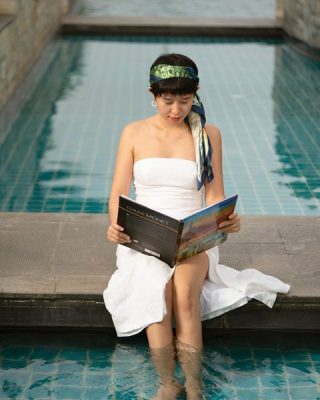
What’s more, as Tagore wrote in his short story “Once There Was a King”, in the old days listeners were satisfied with “there was a king” and eagerly waited for the rest of the story. But today, people ask which king, what was his name, where, when, why, who is telling the story, who “made up” the story, and countless other things they want to understand. So the desire to understand art can be seen as a step forward in the evolution of human awareness.


